Skincare for young people in Malaysia has traditionally meant choosing between two extremes: a relaxing spa facial that ignores biology, or a clinical dermatology visit reserved for medical concerns. Neither addresses the daily reality of oily, changing skin in a tropical climate where humidity and hormones collide. A Gen Z skin studio fills this gap by treating skincare as a trainable skill rather than a luxury service or a medical intervention.
Your skin at sixteen or twenty-two is biologically distinct from adult skin. It needs conditioning protocols built for development, not anti-ageing. SAEBIT operates as a dedicated space for this age group, combining professional skin imaging with Korean skin-conditioning methods adapted for local weather. The goal isn't to fix a flaw. It's to build a trackable foundation of skin health that evolves as you do.
Defining the Gen Z Skin Studio Category
A skin studio for Gen Z works differently from the beauty establishments your parents might frequent, because it prioritises data over relaxation and education over extraction. You're not here to be pampered in silence, and you're not being treated as a patient who needs a prescription for a cosmetic concern. This third space bridges the gap between ineffective home routines and medical-grade interventions, with structured guidance for skin that's still maturing.
Beyond Spas and Clinics: A Third Space for Young Skin
Traditional spas often use generic products built for mature, drier skin, which simply don't match the sebum production of a teenager or young adult. Medical clinics focus on pathology and diagnosis, which can feel alienating when your main concern is managing oiliness or preventing breakouts rather than treating a disease. Understanding the difference between skin studios and dermatologists clarifies why a conditioning model works better for maintenance and prevention than either extreme.
SAEBIT adapts Korean skin-conditioning protocols from Mikwang Academy in Seoul specifically for skin developing in Malaysian heat and humidity (Bernama). This matters because standard K-beauty routines often rely on heavy layering that suffocates pores in our climate, while conditioned skin needs breathable, targeted support. We focus on building resilience through consistent practice, not promising overnight transformations that fade.
Why Generic Facials Miss the Mark for Teens
Most commercial facials treat every client as if they have the same static skin type. That ignores the hormonal volatility that defines young adulthood. Your skin can shift within a single menstrual cycle or exam period, which makes a one-size-fits-all extraction facial irrelevant, sometimes even damaging to your moisture barrier. Skincare for young adults in Malaysia needs flexibility and observation, not rigid adherence to a menu of services built for thirty-year-old professionals.
Generic treatments also skip the education you need for long-term independence, leaving you dependent on monthly visits to manage issues that come from daily habits. A proper teen facial teaches you to read your own skin's signals before problems turn into inflammation. Without that, you stay stuck treating symptoms while the real drivers of congestion and sensitivity go unaddressed.
The Identify Phase: Understanding Changing Skin
You can't condition what you don't understand. That's why every effective skin journey starts with identifying the specific forces at play, inside and out. Hormonal fluctuations drive sebum production and inflammation from within, while Malaysia's heat and humidity create an external environment that makes clogging and dehydration worse. Recognising these drivers behind changing skin helps you stop blaming your complexion for reacting normally to real biological and environmental pressure.
Hormones, Humidity, and Lifestyle Drivers
Young skin is inherently unstable because androgen receptors stay highly active, so oil production spikes unpredictably no matter how carefully you cleanse. Add high ambient humidity, and sweat mixes with sebum and sunscreen to form a film that traps bacteria and blocks natural exfoliation. Irregular sleep during university semesters, or heat exposure after exercise, compound this further, which is why static routines go out of date fast.
Identifying your actual skin type among these variables means looking past surface shine to check barrier integrity and hydration deep in the tissue. Many teenagers mistake dehydrated, compromised skin for purely oily skin and strip it with harsh actives, which triggers a rebound that makes the original problem worse. Accurate identification separates temporary reactivity from chronic conditions, so you can respond with precision instead of panic.
Moving Past Trial-and-Error Routines
Experimentation is a natural part of growing up, but applying unverified internet trends to developing skin often damages the barrier and creates new sensitivities. Many Gen Z consumers are abandoning multi-step routines in favour of skinimalism, choosing fewer products that address actual skin needs over trend-chasing. Knowing which few products to pick is still hard without guidance. Structured observation, instead of guesswork, avoids the cumulative damage of constantly switching acids, retinoids, and cleansers based on viral reviews.
Your routine should evolve based on evidence from your own skin's response to specific ingredients and environmental shifts, not on influencer recommendations aimed at a global audience. Consistency beats intensity when you're managing young skin. The barrier needs time to adapt to any new stimulus before results show. Patience and tracking replace the urge to overhaul your regimen every time a breakout appears.
The Scan Phase: Professional Imaging Over Guesswork
Mirror checks and phone selfies only show surface texture and visible redness. They miss the sub-surface activity that predicts future breakouts. Professional skin imaging reveals pore depth, sebum distribution, and pigmentation patterns the naked eye can't detect, which turns subjective feelings into objective data. That baseline removes the guesswork over whether your skin is actually improving or just having a good day.
JANUS Pro Technology for Deep Analysis
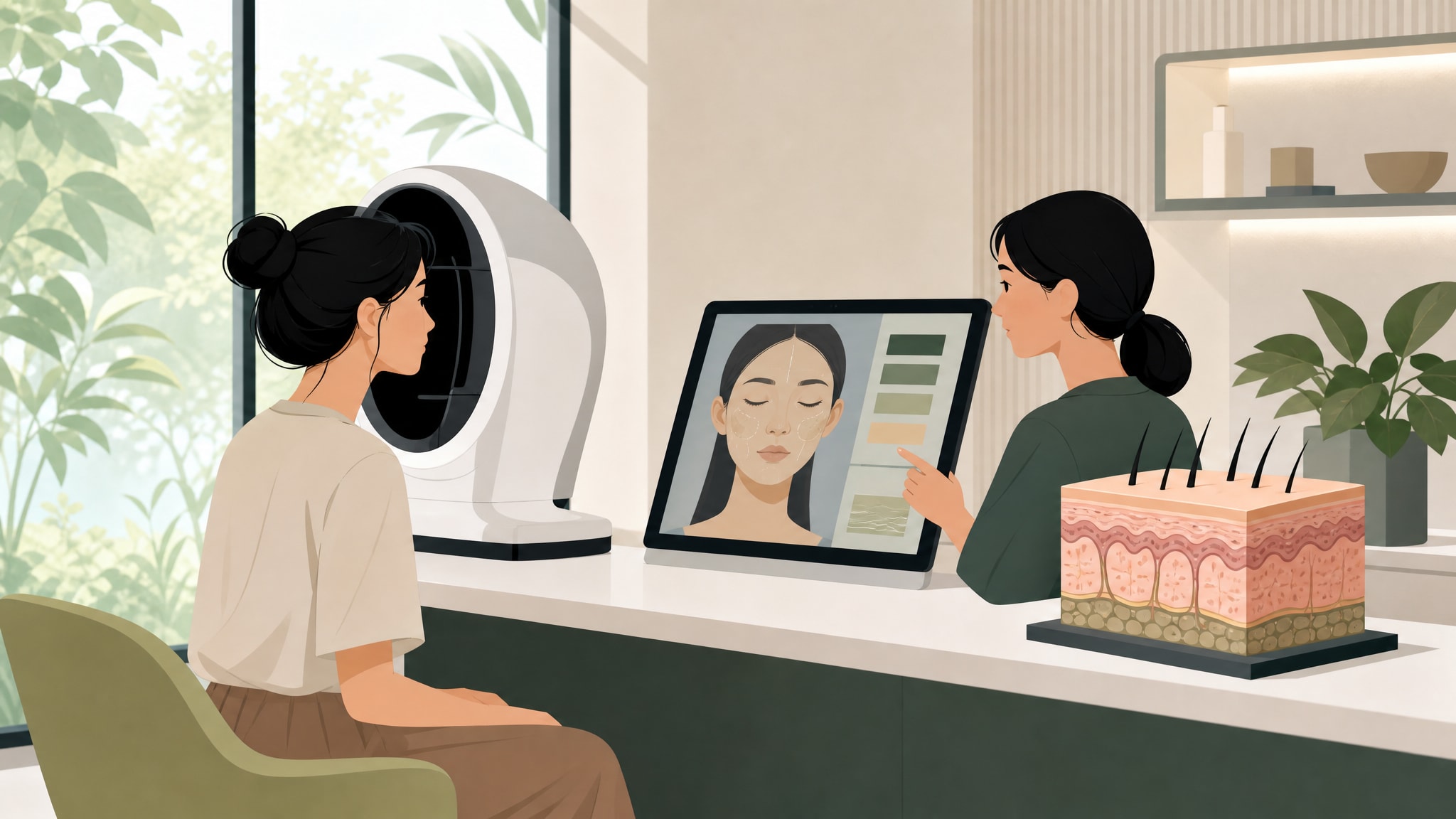
The studio uses JANUS Pro scanning and a 90-second digital Skin Assessment to build objective baselines, rather than relying on subjective visual checks, giving you a clear starting point for your conditioning journey. This technology captures cross-polarised images that show vascular and pigmentary structures beneath the surface, telling active inflammation apart from residual post-acne marks. That distinction matters: treating a mark as if it's an active lesion leads to unnecessary irritation and slower healing.
Professional skin analysis also measures hydration independently of oiliness, correcting the common idea that oily skin doesn't need moisture. Once you see the data, it's clear why stripping oils signals your sebaceous glands to produce more, which feeds a cycle of shine and congestion. Objective measurement replaces the guessing game, so product choices follow evidence rather than marketing claims.
Creating Your Personal Skin Profile
Your scan results feed into a Personal Skin Profile that records your baseline, your sensitivities, and your current concerns in one place. This profile is the reference point for every treatment and product recommendation that follows, so continuity holds even as your skin changes seasonally or hormonally. It turns an abstract idea like "combination skin" into a concrete map of where your face needs hydration and where it needs gentle exfoliation.
A documented profile also protects you from well-meaning but misguided advice from friends, family, or social media personalities who don't know your specific biology. When a new trend tempts you, you can check it against your own data instead. Owning your skin's story this way builds confidence that no amount of external validation can give you.
The Train Phase: Korean Skin Conditioning Protocols
Conditioning differs from treating. Treatment targets a pathology to eliminate it; conditioning strengthens the skin's own capacity to regulate itself under stress. We adapt Korean methodologies to suit life in Bandar Sunway and the surrounding area, where air conditioning and outdoor humidity trade off several times a day. This adaptation means protocols support barrier function instead of overwhelming it with layers built for cooler, drier climates.
Adapting K-Beauty for Tropical Climates
Korean skin philosophy puts hydration and barrier respect first, but traditional multi-step routines often prove too occlusive for Malaysian weather, which leads to milia and fungal acne. Adapting Korean protocols for tropical weather means lighter textures and adjusted application frequency, so the core principles of nourishment and protection hold without the overload. You learn to layer strategically, using humectants that bind water without sealing in the heat or sweat that feeds bacterial growth.
These adapted protocols lean on enzyme-based resurfacing and soothing hydration rather than aggressive physical extractions that risk scarring young, pliable tissue. The goal is to keep pores clear through consistent chemical turnover and manual lymphatic support, not painful squeezing that traumatises the follicle wall. Gentle consistency gets you sustainable clarity; aggressive intervention tends to trigger rebound inflammation that sets progress back by weeks.
Non-Invasive Methods for Barrier Health
Young skin regenerates remarkably well when it's supported correctly, which makes invasive procedures unnecessary, and often counterproductive, for most teen concerns. Non-invasive methods like LED therapy, ultrasonic infusion, and cryotherapy support cellular function and reduce inflammation without compromising the stratum corneum or causing downtime. These work cumulatively, rewarding regular attendance with benefits that compound more like athletic training than surgical correction.
Barrier health is the non-negotiable foundation of all conditioning work. A compromised barrier can't retain moisture or defend against environmental stress, no matter what products you apply on top of it. We prioritise lipid replenishment and pH balance in every session, so your skin leaves stronger than it arrived. Strengthen that defensive layer and sensitivity drops over time, which makes your skin less reactive to both products and environmental stress.
Tracking Progress with the Skin Passport
Improvement in skin health is rarely a straight line, and relying on memory or the odd photo makes it nearly impossible to tell genuine progress from a temporary fluctuation. The Skin Passport keeps a running record of your scans, treatments, and product adjustments, giving you visual proof of trends that daily mirror checks miss. Seeing your journey mapped over months validates the work and keeps you from getting discouraged during the inevitable plateau.
This tracking also builds accountability between you and your skin coach, turning passive appointments into active review sessions where data informs the next step. You can spot patterns linking breakouts to exam stress or travel, and adjust before damage sets in instead of reacting after. Seeing these connections builds the intuitive understanding that eventually lets you manage your skin on your own.
A documented record also guards against the temptation to abandon a working routine for a novel product that promises faster results. When you have evidence your current protocol is improving pore clarity or hydration, you're less likely to derail that for a trending ingredient. Stability becomes the measure of success, not the endless chase for perfection that so much of beauty culture sells.
Modern Skincare for Young Adults in Bandar Sunway
Specialised skin education shouldn't require a trip to a distant city centre or a visit to an intimidating medical setting. Located in Bandar Sunway, SAEBIT serves students and young professionals across Subang Jaya, Puchong, and Petaling Jaya with a studio built to feel approachable and relevant to daily life. Proximity matters because consistency depends on convenience, and removing the logistics makes maintaining your skin as routine as attending class or hitting the gym.
Accessible Skin Education Near Universities
University years are a critical window for building skincare habits that prevent cumulative sun damage and barrier dysfunction later on. Yet this age group often lacks access to credible, non-commercial guidance built for their budget and lifestyle. A teen skin assessment in Malaysia gives you an entry point that respects both your intelligence and your resources, with personalised direction and no upselling.
Education goes beyond product recommendations, into practical skills like reading ingredient labels, understanding SPF ratings, and recognising early signs of barrier distress. These skills let you navigate the skincare market with some discernment, avoiding expensive mistakes and marketing hype. Knowledge you pick up now compounds over decades, through career changes, pregnancies, and the ageing process ahead.
Building Long-Term Habits Early
Skin conditioning mirrors physical fitness: results depend on sustained effort, not the occasional heroic intervention. Starting young lets you normalise preventive care before damage builds up, so maintenance feels like self-respect rather than repair. Early habit formation also cuts your reliance on corrective procedures later, which protects both your skin and your wallet.
The discipline of tracking, adjusting, and respecting your skin's limits carries over into broader life skills around self-awareness and patience. You learn to listen to feedback from your body and adjust your behaviour accordingly, a skill that serves you well in academics, relationships, and work. Skincare becomes a practice of self-knowledge, grounding you in the present while you invest in your future.
Frequently Asked Questions
How is a Gen Z skin studio different from a dermatologist clinic?
A Gen Z skin studio focuses on cosmetic conditioning, education, and tracking for healthy but changing skin, whereas dermatologists diagnose and treat medical conditions like severe cystic acne. Studios use non-invasive protocols and professional imaging to build long-term habits, while clinics typically prescribe medication for pathological issues. Think of the studio as a coach for daily maintenance and the dermatologist as a doctor for acute medical needs.
Can professional skin imaging really see things my mirror misses?
Yes, devices like JANUS Pro use cross-polarised light to reveal sub-surface pigmentation, vascular patterns, and sebum distribution invisible to the naked eye. This objective data distinguishes between active inflammation and residual marks, preventing misdirected treatment efforts. Mirror checks only show surface texture and immediate redness, missing the deeper activity that predicts future breakouts.
Why do Korean skincare routines need adjustment for Malaysia?
Traditional K-beauty routines often involve multiple heavy layers designed for Korea's cooler, drier climate, which can trap heat and sweat in Malaysian humidity. Adapting these protocols means using lighter textures and adjusting frequency to prevent clogged pores and fungal acne while maintaining barrier support. The core philosophy of hydration and respect remains, but the execution must match tropical environmental realities.
What exactly does the Skin Passport track over time?
The Skin Passport documents your professional scan results, treatment history, product adjustments, and observed responses across multiple visits. This longitudinal record reveals patterns linking skin changes to hormones, stress, or seasonal shifts that daily observation misses. It serves as both a progress tracker and a decision-making tool, preventing unnecessary routine changes based on temporary fluctuations.
At what age should teenagers start professional skin assessments?
Professional assessments become valuable when hormonal changes trigger noticeable oiliness, congestion, or sensitivity, typically during secondary school years. Starting early establishes baseline data and healthy habits before damage accumulates from trial-and-error experimentation. There is no minimum age requirement; readiness depends on individual skin concerns and interest in learning proper care rather than chronological milestones.