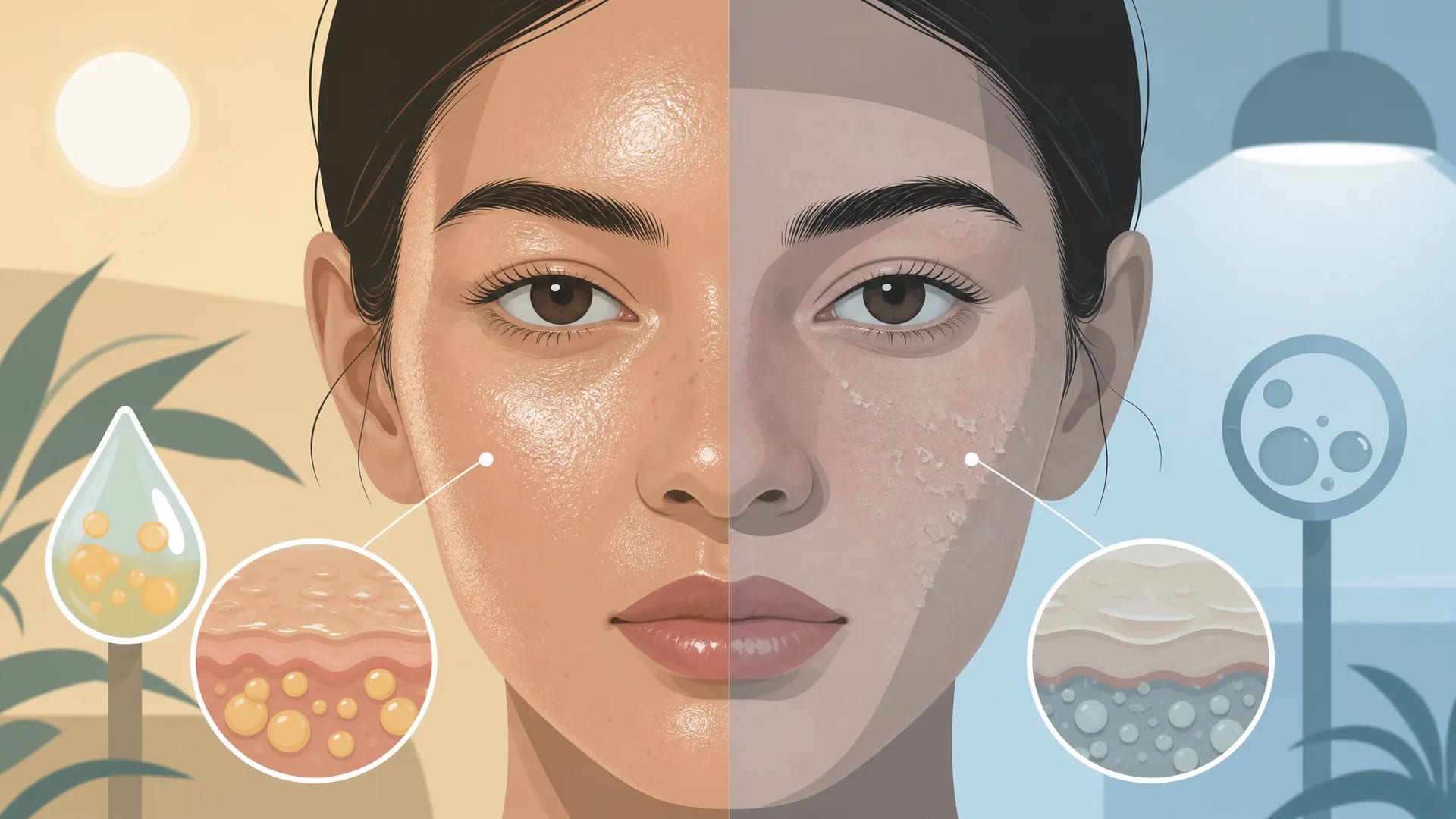
You take a five-question quiz, tick "shiny by lunchtime," and get told you have oily skin. Two weeks later, in an air-conditioned exam hall, your face feels tight and flaky. So which is it? This is the exact confusion behind learning how to read your skin type accurately. Most quizzes measure how your skin looks right now, not what it actually is underneath.
Why Most Skin Type Tests Get It Wrong
Classic five-type quizzes (oily, dry, combination, normal, sensitive) treat your skin like a fixed label you can spot in one glance. Skin doesn't work that way. What you're seeing at any given moment is a mix of your genetic baseline and whatever your environment, sleep, and stress did to your face that day. A quiz taken after a sweaty commute and one taken fresh out of the shower can spit out two different answers for the same person.
That's the first thing to understand if you want to learn how to read your skin type accurately: a snapshot is not a baseline.
Skin type vs skin condition: the difference nobody explains
Skin type is genetic and stable. It's set by how much oil your sebaceous glands naturally produce, and it doesn't change month to month. You're broadly oily, dry, combination, or normal, and that stays fairly constant through most of your life, though it can shift gradually with age and hormones.
Skin condition is temporary. It's the surface state layered on top of your type: dehydration, congestion, redness, sensitivity flare-ups. Conditions change daily, sometimes hourly, based on weather, diet, sleep, skincare products, even how much you touched your face in class.
Here's why that distinction matters. A naturally dry-type person can develop oily, congested skin conditions from over-cleansing or humidity. Someone with a genuinely oily type can feel tight and dehydrated if they're using harsh products or blasting the aircon all day. Test either of them on the wrong day, and a standard quiz will call them the opposite of what they actually are. That's why skin type vs skin condition is the real starting point, not an afterthought.
How Malaysian Humidity Skews the Self-Diagnosis
Malaysia's average humidity sits well above 70% year-round, and that keeps skin surfaces oilier and more reactive than the same skin would appear in a cooler, drier climate. That single fact quietly wrecks most self-assessments done here using guides written for temperate countries.
High humidity keeps sebum sitting on the surface longer instead of evaporating or absorbing, so almost everyone reads shinier and greasier than their true baseline. A teen who is genuinely combination or even normal-type can easily mistake themselves for fully oily, simply because Malaysian air behaves differently than the climate most beauty content was written for.
This is the core of how climate affects skin type readings. Your type doesn't change with the weather. The same type presents very differently depending on temperature, airflow, and moisture in the air.
A teen in Puchong might test "oily" at 3pm after a hot commute home, but read as balanced or even dry-leaning at 9am right after waking. That swing is climate, not true type. If you only ever check your skin in the afternoon heat, you'll never see your actual baseline, only the humidity's effect on it.
Can Your Skin Type Actually Change?
Your underlying skin type is genetically set and doesn't shift day to day. What changes constantly is how it presents, the condition layered on top. So no, you don't wake up "dry" on Monday and "oily" on Friday in any real biological sense. What's changing is hydration, oil buildup, congestion, or sensitivity reacting to that day's conditions.
Skin type can shift slowly over years, especially through puberty, hormonal changes, or ageing, which is exactly why teen skin needs a different read than adult skin. But it won't flip week to week based on weather or stress alone. If your self-checks feel wildly inconsistent, the problem usually isn't your skin changing. It's the conditions you're checking it under.
A Step-by-Step Way to Self-Check Skin Type at Home
If you want a genuinely useful answer to how to read your skin type accurately, do this instead of a one-off quiz:
- Cleanse and wait. Wash your face with a gentle cleanser, then leave it completely bare, no products, for one hour.
- Check in a stable environment. Do this indoors, away from direct sun, fans, or aircon vents, so airflow doesn't distort the reading.
- Blot different zones. Use blotting paper or tissue on your forehead, nose, cheeks, and chin separately. Note which zones show oil and which stay dry.
- Repeat at two different times of day. Once in the morning, once in the late afternoon. Compare the results rather than trusting either one alone.
- Repeat across a few days. A single day can be thrown off by sleep, diet, or a particularly humid afternoon. Three to five days gives you a pattern, not a snapshot.
- Separate what you see from how it feels. Shine is oil. Tightness or flaking is often a condition (dehydration), not your type.
This method won't be lab-accurate, but it's far closer to your true baseline than any single quiz result, because it accounts for the timing and environment problems that trip up most self-diagnosis.
Why Combination Skin Confuses So Many People in Malaysia
Combination skin is already the trickiest of the classic categories, and combination skin in Malaysia gets even harder to read because of the climate stacking on top of it. Classic combination skin means an oily T-zone (forehead, nose, chin) with drier or normal cheeks. In consistently humid weather, that oily zone tends to spread. Cheeks that would read as "normal" in a temperate country can pick up enough ambient moisture and sebum to look oily too, especially by midday.
That makes a genuinely combination-type teen look fully oily on paper, while someone who is actually oily-type looks combination because their cheeks are only slightly less shiny than their T-zone. The categories blur into each other under humidity, which is exactly why so many Malaysian teens land in the "combination" bucket by default, whether or not it's accurate.
Blotting different zones separately, as in the self-check above, is the most reliable low-tech way to tell true combination skin apart from an all-over humidity effect.
Do Skin Type Quizzes Actually Work for Teens?
Not particularly well, and for a specific reason: teen skin is going through active hormonal changes that adult skin isn't. A teen skin type quiz built for general audiences doesn't account for puberty-driven oil production, which can make a teen's true baseline harder to separate from a temporary hormonal spike.
Quizzes also can't account for climate, time of day, or the skin type vs skin condition split at all. They're designed as quick content, not diagnostic tools. That's not a knock on trying one for fun. It's a reason not to treat the result as final, especially if you're a teen in a tropical climate whose skin is already more volatile than the quiz format assumes.
When to Stop Guessing and Get a Professional Scan
Self-checks and careful observation get you a reasonable working theory. But at some point, guessing has diminishing returns, especially if your skin behaves inconsistently no matter how carefully you test it, or if congestion, breakouts, or sensitivity keep showing up in ways you can't explain.
That's the point to get an actual scan rather than another quiz. Saebit's free 90-second digital Skin Assessment is built specifically to separate skin type from skin condition before a teen ever sets foot in a studio. It's a fast, low-commitment first step if you've done the blotting-paper method and still aren't confident in what you're looking at.
For a definitive answer, JANUS Pro scanning gives a Personal Skin Profile that separates baseline oil production from surface conditions like dehydration or congestion, something a mirror check can't do. It reads the skin at a level no blotting paper or mirror check can reach, and that matters a lot in a climate that actively disguises true skin type.
This isn't guesswork built for a different country's weather, either. Korean skin-conditioning protocols were designed for humid East Asian climates, which is why Saebit adapts Mikwang Academy's Seoul-based methods rather than importing Western dry-climate routines wholesale. That's a meaningful difference if most of the skincare advice you've come across online was written with cooler, drier climates in mind.
The Bottom Line
Learning how to read your skin type accurately starts with separating type from condition, checking yourself at multiple times of day, and accounting for the fact that Malaysian humidity will always push readings toward "oilier" than a temperate-climate quiz expects. Do the home self-check over a few days first. If the picture still isn't clear, take the free Skin Assessment, and treat an in-studio JANUS Pro scan as your definitive answer.