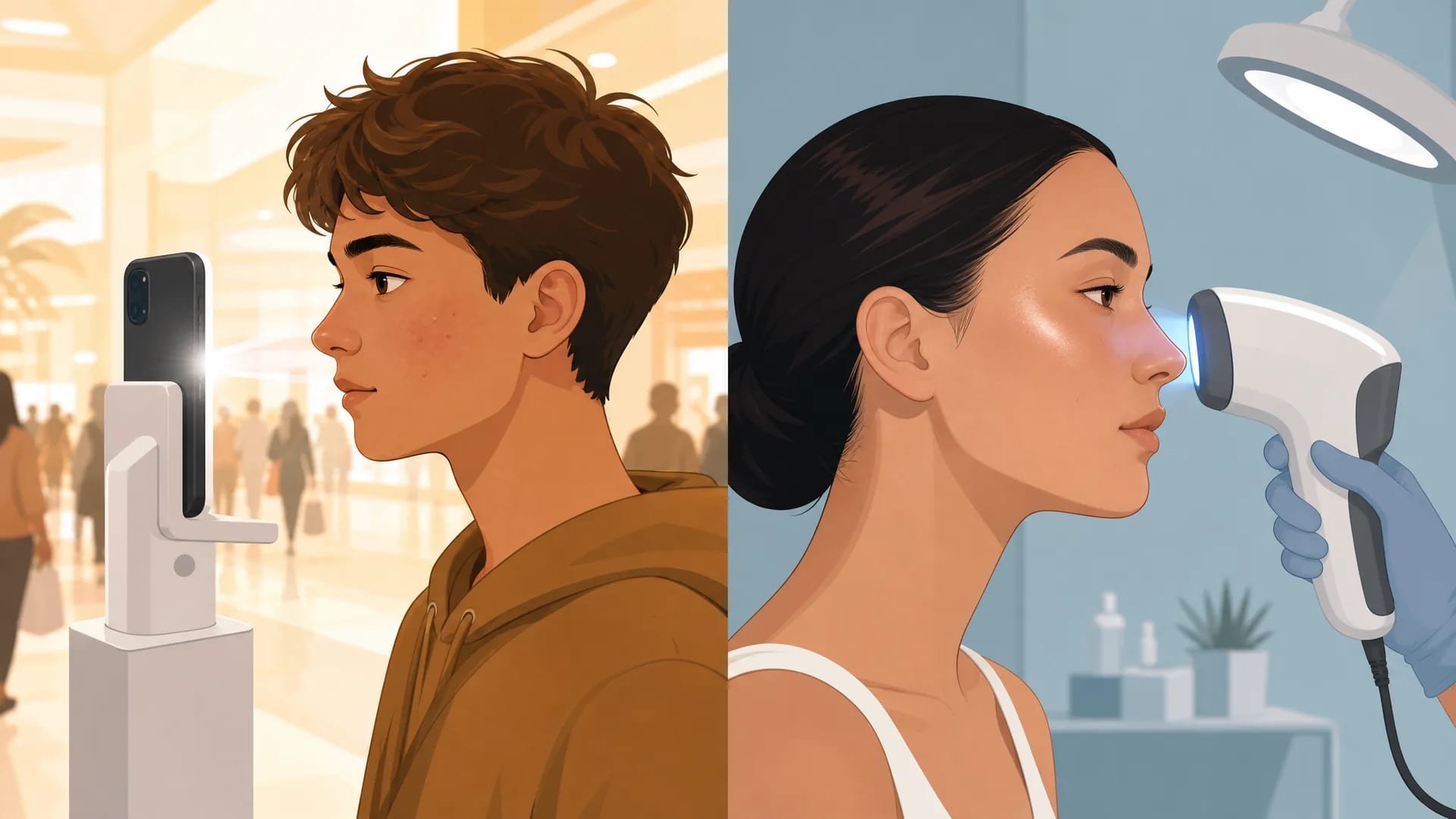
You've probably seen it: a kiosk at the mall, a booth at the pharmacy, or a friend's Instagram story showing a face scan with colorful percentages splashed across it. Now you're wondering how that compares to an actual professional scan. Is the free version good enough to build a skincare routine on? That's the real question behind the Janus Pro scan vs iPad scan comparison, and it deserves a straight answer, not a sales pitch.
This isn't about pushing one gadget over another. It's about understanding what each tool can actually see, so you don't end up treating the wrong problem.
Why Everyone's Comparing JANUS Pro Scan vs iPad Skin Scan Right Now
Skin scanning has become a fixture of daily life for teens across Bandar Sunway, Puchong, Shah Alam, and Petaling Jaya. Pop-up booths, beauty counters, and skincare apps all offer some version of "scan your face, get instant results." It feels harmless and fun. But the results from these tools vary wildly, and most teens have no way to know why.
That gap in understanding is exactly why the comparison matters. A professional JANUS Pro skin scan in Malaysia and a quick iPad scan at a kiosk aren't the same category of tool, even though they look similar on the surface.
Where teens are seeing iPad skin scans (malls, pharmacies, social media)
Walk through any mall in Subang Jaya or Damansara and you'll likely pass a skincare brand's activation booth. They set up an iPad, ask you to look at the camera, and hand you a printout full of scores within seconds. Pharmacies do the same thing to sell serums. Social media adds another layer, with filters and apps promising to "analyze your skin type" from a selfie.
None of this is inherently dishonest. But it creates a quiet assumption: that a scan is a scan, wherever it happens. This article is here to correct that.
How an iPad Skin Scan Actually Works
An iPad skin scan uses the tablet's built-in camera and whatever light is available in the room. There's no special sensor, no controlled environment, and no calibration step. The app runs the photo through image-processing software and turns that into a set of scores, usually for things like pores, spots, and wrinkles.
The core issue: the camera reads light bouncing off your skin's surface, in a room you don't control. Mall lighting, pharmacy fluorescents, and window glare all change what the camera sees. So does the angle you hold the device at, and even which model of iPad or phone you're using.
What iPad skin analysis accuracy really depends on
Is an iPad skin scan accurate enough to build a routine on? Mostly, no. The reason comes down to conditions, not the app's intentions.
iPad skin analysis accuracy depends on ambient light, camera quality, distance from the lens, and how still you hold your face. Change any one of those, and the score changes with it. This is why skin scan results differ between a mall kiosk and an in-studio scan. The kiosk isn't measuring your skin consistently. It's measuring your skin under that day's specific light and camera setup.
That makes the reading closer to a fun snapshot than a diagnostic. It can hint that something's off, but it can't reliably tell you what.
What a JANUS Pro Skin Scan Measures That an iPad Can't
A professional scan is built around consistency. Saebit's in-studio JANUS Pro scan uses calibrated lighting and multi-spectrum imaging to read sub-surface conditions like oil activity and hydration depth, not just what's visible on the surface. That's the core difference in professional skin scan vs app scan comparisons: one reads reflected light in a random room, the other reads structured, repeatable data under fixed conditions.
Surface vs sub-surface: what does a JANUS Pro scan measure
So what does a JANUS Pro scan measure, specifically? It looks past the surface layer to check oil production beneath the skin, hydration levels at different depths, pore congestion, and sensitivity indicators that aren't visible to a regular camera.
This surface vs sub-surface distinction changes everything. A teen with visibly dry, flaky skin may actually be oily underneath and dehydrated on top, a distinction an uncalibrated iPad camera under mall lighting simply can't pick up. An iPad scan would likely flag "dry skin" and stop there. A JANUS Pro scan can show that the real issue is dehydration layered over excess oil, which calls for a completely different approach.
Calibrated lighting and camera conditions explained
Do lighting and camera conditions really change skin scan accuracy? Yes, substantially. That's why calibration matters so much in professional skin scanning technology comparisons.
In an in-studio setting, the lighting is fixed, the camera distance is fixed, and the imaging conditions don't change from one client to the next or one day to the next. That means your results today can be meaningfully compared to your results next month. A mall kiosk resets those variables every single time someone new steps up to it. For a deeper look at how the technology itself works, the JANUS Pro explainer walks through the imaging process in more detail.
Professional Skin Scan vs App Scan: Why the Gap Matters for Teens
This isn't just a technical detail. It changes what a teen does next with their skin.
Say a shallow scan tells you your skin is "dry" and you respond with heavier creams. If the real issue underneath is excess oil, you can end up making breakouts worse. Chasing the wrong priority because of a shallow reading wastes time, money, and confidence, especially during the teenage years when skin is already changing fast.
Free skin assessment vs in-studio scan: which comes first
This is where the order matters. Saebit's journey starts with a free 90-second digital Skin Assessment before any in-studio scan, so no one has to commit before understanding what a deeper scan adds. The digital assessment is a low-pressure first step. It's not trying to replace a full scan. It's designed to point you toward whether an in-studio JANUS Pro scan makes sense for your specific skin situation.
That sequence, free skin assessment vs in-studio scan, gives teens and parents a clear, no-risk starting point, with the option to go deeper once there's a real reason to.
Reading Your JANUS Pro Results in Malaysia's Climate
Skin doesn't behave the same way in Malaysia's heat and humidity as it does in cooler, drier climates. Oil production, sweat, and hydration all shift in tropical conditions. That's exactly why sub-surface readings matter here more than in many other markets.
Saebit adapts Korean skin-conditioning protocols from Mikwang Academy in Seoul specifically for skin developing in Malaysian heat and humidity, using non-invasive methods only. That local adaptation matters for teens in Petaling Jaya, Bangsar, Taman Tun Dr Ismail, and Cyberjaya, where humidity stays high for most of the year. A protocol built for a temperate climate won't necessarily fit skin dealing with constant moisture and heat exposure.
Reading your JANUS Pro results with this climate context in mind helps explain readings that might otherwise seem confusing, like high surface oil paired with under-hydrated deeper layers. That combination shows up often in tropical conditions.
How to Use Your Scan Results to Build a Real Skin Plan, Not a Novelty Reading
A scan on its own, however accurate, is just data. The value comes from how you read the data and what happens next. At Saebit, results feed into a Personal Skin Profile aka Skin Passport, which becomes the basis for ongoing Skin Training Sessions and skincare routines rather than a one-time fix.
This is the shift from novelty to plan. Instead of reacting to a single score, you're working from a baseline that gets refined over time as your skin responds to changes in routine, weather, and habits.
Tracking skin progress over time after your first scan
One scan is a starting point, not a verdict. Skin changes with stress, diet, weather, and age. Tracking PROGRESS over repeated scans shows what's actually working and what isn't.
For teens and young adults juggling school, exams, and growth-related skin changes, this kind of tracking matters more than a single snapshot ever could. It turns skin care into something closer to a training plan than a guessing game.
If you've only ever had the mall kiosk version, the difference is worth seeing for yourself. Booking a free 90-second digital Skin Assessment is a low-pressure way to find out where your skin actually stands, and whether an in-studio JANUS Pro scan is the right next step for building a plan that fits your skin, not just a screen.