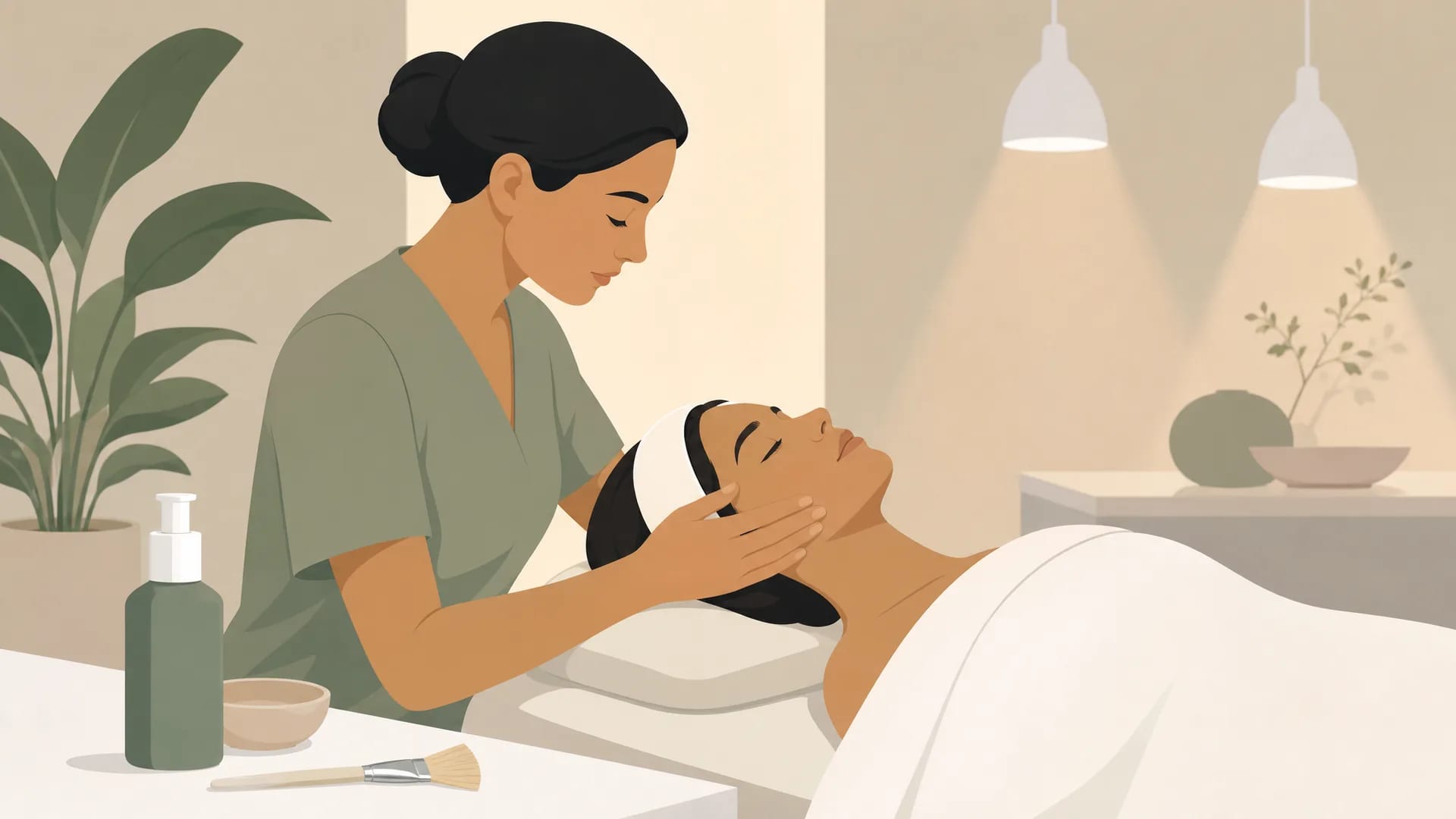
If you've watched even a little skincare content, you've heard that "Korean facials just hit different." And it's true. But not for the reason most people think. It's not about one magic machine or a fancy address. The real difference is a whole approach to skin: how it's assessed, how it's customized, and what the treatment is actually trying to do.
Once you get that, choosing a facial stops being about vibes and starts being about what your skin actually needs. Here's the honest breakdown for anyone in their teens or twenties trying to figure it out. And yes, the Korean approach is exactly what we're built around at Saebit.
The Core Difference: Results vs. Relaxation
The simplest way to understand it: the typical Western spa facial is trying to refresh your skin, and the Korean approach is trying to improve it.
A standard spa facial is built around the experience — comfort, a nice massage, a temporary glow. Lovely, but the effect fades in a few days because that was never really the goal. The Korean way flips the priority. The experience still matters, but the point is measurable, long-term change: skin that's genuinely in better shape a month from now than it is today.
Neither is "wrong." They're just aiming at different targets. You just want to know which one you're actually booking.
What Each One Is Actually Fixing
A usual facial spa is chasing the moment: relaxation, a hit of hydration, and a short-term glow from surface-level cleansing and exfoliation. Perfect when you just want to feel refreshed.
The Korean approach is chasing specific outcomes: calmer acne and clearer pores, more even tone and fading pigmentation, smoother texture, and healthier skin over time. It's the move when you've got real concerns you actually want to see improve — not just cover up for a night.
What "The Korean Approach" Actually Means
Here's the myth to bust: people assume "Korean facial" means "a laser in a dermatology clinic." Those high-end Gangnam clinics exist, sure — but that's the medical extreme, and it's not what defines the Korean style. What actually makes it Korean is a mindset, and it shows up whether you're in a clinic or a skin studio:
That's the philosophy. And the beautiful part is you don't need a doctor's office to get it — a skin studio delivers exactly this approach in a warmer, more personal, more affordable setting. (If something ever genuinely needs medical treatment, a good studio tells you straight and points you to a clinic. No overpromising.)
Diagnostic-First Approach: Why Korean Protocols Start With Assessment
Read the skin first before touching it. A proper skin analysis before anything happens, so the treatment fits you, not a generic package.Skin conditions change week to week, especially for teens and young adults still figuring out their oil production and hormone patterns. A protocol that ignores this and applies the same steps every time will eventually get it wrong.
Before any product touches the face, a proper Korean-style session reads three things: hydration, oil balance, and sensitivity. Each of these affects which steps are safe and which will backfire.
Skin that's dehydrated but oily needs a completely different approach than skin that's genuinely dry. Skipping this step means guessing. Guessing on still-developing skin is a bigger risk than guessing on skin that's already stable.
What a Skin Passport Actually Tracks
Saebit's free 90-second digital Skin Assessment and in-studio JANUS Pro scan generate a Personal Skin Passport before any treatment step begins. That profile tracks hydration, oil levels, sensitivity, and visible concerns like congestion or texture.
A diagnostic-first session flags oil balance and sensitivity levels first. That lets a Skin Coach to prioritize one issue at a time, instead of applying the same steps to every client regardless of what's actually going on underneath.
This is what a diagnostic skin facial looks like in practice. It's not a buzzword. It's a specific sequence: scan, profile, then plan. If you're curious about the tool behind that scan, it's worth reading how JANUS Pro scanning works.
Non-Invasive Extraction Methods vs Traditional Squeezing
Extraction is where the contrast between Korean and Western facials shows up most clearly. Many regular facials still rely on manual squeezing, sometimes with fingers, sometimes with a metal tool pressed hard against the skin. It works, but it's rough, and it can bruise or scar skin that hasn't fully matured.
Korean conditioning protocols lean toward gentler, tool-assisted or enzyme-led methods to clear pores instead. The goal is the same, clear congestion, but the method avoids the trauma that comes with force.
For teen skin, this matters more than it sounds. Skin barriers are still forming through the teenage years. Aggressive extraction can leave marks that take longer to fade than the original blemish. A gentler approach gets a similar result without the same setback. This is part of why the debate over whether teenagers should get facials at all usually comes back to technique, not whether extraction happens.
Enzyme Resurfacing and Layered Low-Irritation Steps
Enzyme resurfacing works by gently breaking down dead skin cell buildup rather than manually squeezing or scrubbing. It's a chemical, not physical, process. Enzymes loosen the buildup so it lifts away with minimal friction.
Compare that to a harsh scrub or an aggressive peel, both of which can strip healthy skin along with the dead layer. Enzyme resurfacing is more targeted. It clears what needs to go without over-treating what doesn't.
Why Layering Beats a One-Shot Treatment
Korean protocols also tend to favor several light steps over one intense step. Instead of one strong product doing all the work, you get multiple gentler layers, each doing a small part of the job. Treat in layers, think long-term. It's about steady, cumulative progress, not a one-time miracle.
This matters for barrier health, especially in skin that's still developing. One aggressive treatment can overwhelm a barrier that isn't fully resilient yet. Several light layers spread the work out, so the skin isn't shocked by any single step.
It's also a more measurable way to treat skin. If a layer doesn't suit that day's skin condition, the therapist can skip or swap it. Undoing a one-shot peel that's already gone too far isn't nearly as easy.
Korean Machines and Tools Used in Skin Conditioning Protocols
Technology plays a real role — think LED light, microcurrent, guided exfoliation, extractions, and professional-grade protocols — matched to your skin rather than thrown at it. Korean machines and skincare aren't there for show. Their job is to make treatment measurable instead of guesswork, which lines up with the diagnostic-first philosophy running through the whole protocol.
Most of the tools behind a good Korean-style facial are gentle, relaxing, and honestly kind of satisfying. Here's what they actually are and what they do:
LED light therapy. Different colours of light do different jobs — red light supports cell turnover and calms the skin, blue light targets the bacteria behind breakouts. It's completely painless; you just lie there under a warm glow. Great for acne and for recovery.
Microcurrent. Tiny, gentle electrical pulses that work the muscles under your skin — people call it a "natural workout for your face." It's used for a lifted, toned, more sculpted look, and it feels like a light tingle at most.
Ultrasonic treatments. High-speed vibrations that deep-clean pores, sweep away dead skin, and help good ingredients absorb better. This is where a lot of that "my skin has never been this smooth" feeling comes from.
Microdermabrasion / hydro-exfoliation. A controlled way to buff off dull, dead surface skin — either mechanically or with a water-and-serum system that cleans, exfoliates, and hydrates in one go. Instant softness, zero drama.
Galvanic and high-frequency. Gentle currents that help clear congestion, calm acne-prone skin, and push hydrating ingredients deeper. Small tools, surprisingly noticeable difference.
Cooling and oxygen treatments. Cryo globes and oxygen infusion to de-puff, soothe redness, and leave skin looking fresh and awake.
The point isn't to use all of it on you. It's to pick the right tools for your skin which loops right back to the Korean approach: analyze first, then treat with intention.
And just to be clear about the line: the heavy medical tech — ablative lasers, laser toning, injectable "skin boosters," deep medical peels — lives in a dermatology clinic and, in Malaysia, has to be done by licensed medical practitioners. Saebit Skin isn't trying to replace that. It's giving you the results-driven Korean approach with the tools an expert aesthetician can safely and genuinely deliver. And pointing you to a clinic if you ever need the medical stuff.
Adapting Korean Facial Protocols for Malaysian Heat and Humidity
Malaysia's year-round heat and humidity push oil and sweat production higher than in temperate climates. That's a problem for anyone copying a Korean skincare philosophy built around Seoul's drier, more seasonal weather without adjusting it.
A protocol designed for cooler, drier air often layers heavier products for hydration. In Bandar Sunway, Puchong, Shah Alam, or Subang Jaya, that same layering can trap oil and heat instead of helping. The steps have to be lighter, more breathable, and more focused on oil control.
This is why protocol adaptation matters as much as the protocol itself. A Korean facial that ignores climate isn't actually built for the skin sitting in front of it. For a practical version of this, there's a Korean skin conditioning routine built for tropical heat that reworks the standard steps for exactly this climate.
Why This Matters for Teen and Young Adult Skin
Teen and young adult skin in Malaysia deals with a double challenge. It's still developing, and it's doing so in a hot, humid climate that pushes oil production higher than most routines were built for.
Generic routines borrowed straight from Seoul don't account for either factor. A diagnostic-first, low-irritation approach does, because it reads the skin's actual condition instead of assuming a fixed climate or a fixed age group.
That's also where the difference between a facial and real conditioning becomes clear. If you want to understand how conditioning differs from a typical facial, the short version is: conditioning tracks progress over multiple sessions, a one-off facial doesn't.
You don't need a dermatology clinic to get the Korean approach. You just need Saebit Skin that actually reads your skin, adjusts to it, and plays the long game with you.
Start With a Real Assessment, Not a Guess
The clearest way to answer how Korean facials differ from the rest is this: they start by understanding the skin, not by running through a checklist. Diagnostic-first assessment, non-invasive extraction, enzyme resurfacing, layered steps, and measurable tools all follow from that one decision. It's about philosophy: results-focused, deeply customized, and built for long-term skin health — versus relaxation-focused and short-term.
For young, still-developing skin in Malaysia's climate, that starting point matters even more. It's the difference between a routine that guesses and one that adjusts.
If you're in Bangsar, Taman Tun Dr Ismail, Cyberjaya, Damansara, or nearby, the best next step is starting with a proper skin assessment rather than a fixed set of steps. Book a free 90-second Skin Assessment or a full Skin Training Session at Saebit, and see what a diagnostic-first Korean protocol actually looks like on your own skin.
Actually Korean — Not Just "Korean-Inspired"
Here's a little industry secret: loads of places love to sprinkle the word "Korean" on their menu while using generic machines and whatever products the supplier happened to have. "Korean-inspired" is doing a lot of heavy lifting in that sentence.
At Saebit, it's the real thing. The machines are imported directly from Korea — the same kind of professional devices Korean skin experts actually use — and the skincare products are Korean too, formulated in the country that basically wrote the modern skincare playbook. If you've ever fallen down a K-beauty rabbit hole and wished you could get the professional-grade version of that whole world, this is it.
Why does that matter for your skin? Because the Korean approach isn't just a technique — it's a whole ecosystem of ingredients and technology designed to work together, layer by layer. Using authentic Korean machines with authentic Korean products means you're getting that system as it was meant to be, not a watered-down imitation of it.
It's the difference between "we do a Korean-style facial" and "we brought the actual thing here."