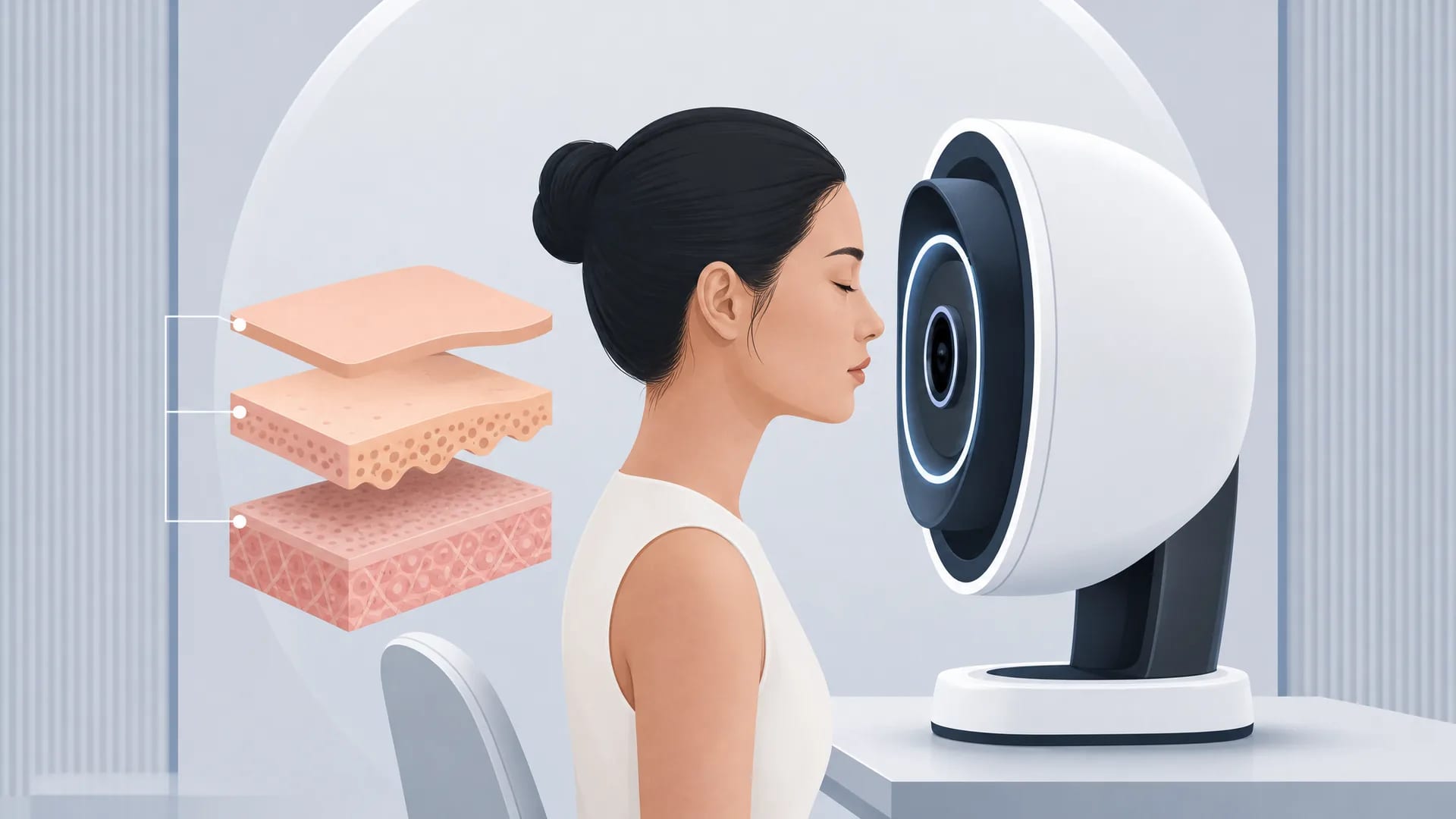
Most people check their skin the same way: lean into a mirror, tilt the head, decide "oily" or "dry" based on how the light hits at 8am. That's a guess, not data. A JANUS Pro skin scan Malaysia studios use works differently. It images your skin the way a coach reviews game footage, layer by layer, so nothing is left to lighting or mood.
What Is a JANUS Pro Skin Scan?
JANUS Pro is a diagnostic imaging device, not a beauty gadget. It captures multiple layers of your skin's condition in one sitting: surface texture, oil distribution, hydration, and deeper pigmentation or UV damage that sits below what your eyes can see. A mirror only ever shows you the top layer, and even then, only in the light you happen to be standing in.
At Saebit, the scan isn't the first step. It comes after the free 90-second Skin Assessment, a quick digital screening that flags what's worth a closer, in-studio look. Think of the assessment as the warm-up and the scan as the actual fitness test.
How JANUS Pro Works
You sit in front of the device for a short imaging session. It's non-invasive. No needles, no extractions, nothing pressed into the skin. The scanner uses light-based imaging to read multiple skin layers at once, producing a readout of texture, oil, hydration, and pigmentation patterns. Nothing about it is painful, and for teenage skin specifically, that matters: there's no reason a first scan should feel like a clinical procedure.
Why Studios Use It Instead of Just Looking
A trained eye can spot obvious breakouts or dryness. What it can't do is quantify oil distribution across different zones of the face, or catch UV-related pigment changes that haven't surfaced yet. Studios use JANUS Pro because it turns "your skin looks fine" into an actual number your coach can track over time, session after session.
What Each Scan Layer Shows
Every scan produces more than one picture. Some readings describe what's happening on the surface right now. Others describe damage that's been building underneath for months or years, invisible until the scanner picks it up.
Surface Layer: Texture, Pores, and Oil Balance
This layer shows what a mirror is trying, and failing, to tell you. It maps pore size and visibility, surface roughness, and how oil is distributed across the T-zone, cheeks, and jawline. None of this is a diagnosis of "bad skin." It's a training data point. If oil is concentrated unevenly, that's useful information for a coach building your routine, not a verdict on your appearance.
Deeper Layer: UV Damage and Pigmentation Build-Up
This is the layer a mirror can never show you. It reads pigment concentration sitting below the visible surface, often the early stage of sun spots or unevenness that hasn't become visible yet. For teens, this reading is arguably more useful than anything on the surface, because it flags a problem while there's still time to change course before it shows up as a visible mark.
Reading Your JANUS Pro Scanner Results Explained
Your JANUS Pro scanner results, explained simply: a printout with numbers and colour-coded maps, one per skin metric. Higher numbers or warmer colours (often orange to red) usually flag areas needing more attention; cooler tones or lower numbers mean the metric is in a healthier range. The exact scale depends on the metric. Hydration, oil, texture, and UV pigmentation are each scored separately, not lumped into one overall "score."
Numbers and Colour Maps: What They Mean
Don't try to read the map like a report card. A high oil reading in the T-zone next to a low hydration reading on the cheeks isn't a contradiction. It's a common pattern, and it tells your coach exactly where to focus first. The colour map is a visual shortcut to where readings cluster, so you can see at a glance which zones need work rather than scanning a page of numbers.
Common Results Malaysian Teens See
Two patterns show up often in-studio: elevated surface oil (Malaysia's humidity keeps oil production active most of the year) and early-stage UV pigmentation, even in teens who don't spend much time deliberately sunbathing. Neither is unusual. Both are exactly why the scan exists: to catch these things before they become bigger concerns. Every JANUS Pro scan at Saebit feeds into a Personal Skin Profile that your coach references at each Skin Training Session, so progress is tracked scan over scan, not guessed at.
UV Skin Analysis for Teens: Why It Matters More Than It Seems
It's tempting to file UV damage under "future you's problem." But UV skin analysis for teens matters now, because pigment changes accumulate quietly for years before they're visible in the mirror. A scan catches that build-up early, while a routine can still influence how it develops.
Tropical Sun Exposure and Young Skin
Malaysia's climate means near-constant UV exposure, all year round, with no real "off season" the way some countries get in winter. Skin in tropical humidity also produces more surface oil, which is why a single mirror-check misses cumulative UV damage that a scan layer can flag early. A 16-year-old who looks "clear-skinned" in the mirror can still show high UV-damage readings and uneven oil distribution under the scanner. The two pictures often disagree, and the scanner is the one worth trusting.
Why Scanning Beats Guessing Your Skin Type
"Am I oily or dry?" is the wrong question to answer by feel. Skin type isn't one fixed label. It varies by zone, by humidity, by week. A scan measures it directly instead of asking you to guess from how your face feels at 3pm.
Mirror Checks vs In-Studio Skin Analysis
Social media skin-type quizzes and mirror checks rely on self-report: how tight does your skin feel, how shiny does it look. In-studio skin analysis instead measures oil, hydration, texture, and pigmentation as separate readings, each with its own number. That's the difference between a guess and a measurement, and it's why two people who both call themselves "combination skin" can have completely different scan results underneath.
When a Scan Changes Your Skincare Plan
Sometimes a scan confirms what you suspected. Often, it doesn't. A reader convinced their skin is purely oily might find the scan flags dehydration underneath that oil, a pattern that calls for a different approach entirely. This is also where a scan result showing persistent breakout patterns is worth pairing with a clearer picture of how teenage acne differs from adult acne, since the two respond to different routines. Once you know what the scan actually shows, guessing stops being necessary.
What Happens After Your Scan at Saebit
Your JANUS Pro results don't stop at the printout. They become your Personal Skin Profile, a working record your coach uses at every future Skin Training Session, so each visit builds on the last instead of starting from zero. From there, your coach translates the readings into a plan: what to prioritize first, what routine changes matter, and what to leave alone for now.
Saebit adapts scan-reading protocols from Mikwang Academy in Seoul, translating Korean skin-conditioning standards for skin developing in Malaysian heat and humidity. That's also where a scan result can lead somewhere practical, into Korean skin conditioning routines built for tropical heat, so your data turns into a routine you can actually follow.
If you haven't started yet, the first step is simple. Book the free 90-second Skin Assessment, and let a JANUS Pro scan tell you what your mirror never could.