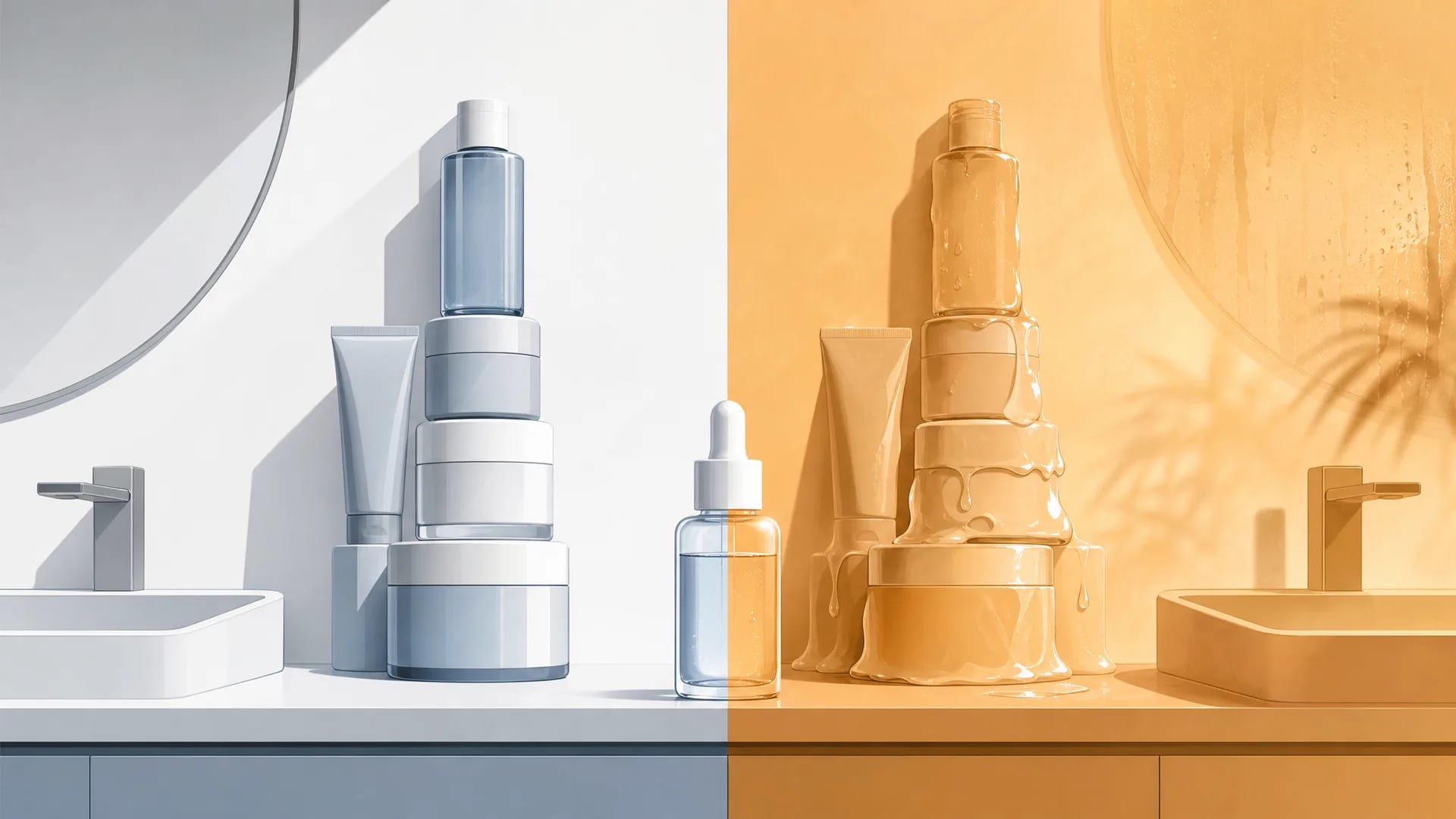
You've seen the routines. Ten steps, glass skin, a shelf of Korean products lined up like a science experiment. But a routine built in Seoul was built for Seoul's air, not for Kuala Lumpur's. If your skin still breaks out, gets shiny by noon, or flakes under makeup despite following every step correctly, the routine isn't wrong. It's just untranslated.
This is where a Korean skincare protocol for tropical climates needs its own logic, not a copy-paste from a Seoul skincare guide.
Why Seoul Skincare Doesn't Transfer Directly to Kuala Lumpur
Korean skincare methodology is genuinely good at reading and calibrating skin. But it was built inside a specific climate. Seoul has cold, dry winters and short, humid summers. Malaysia has neither. This one fact changes almost everything downstream, from product texture to how often skin needs attention.
What changes when you move from Seoul to KL
In Seoul, a heavier cream or layered essence routine makes sense for much of the year, because the air itself pulls moisture out of skin. In KL, that same heavy layering can trap heat and oil against the skin. That shows up as clogged pores or breakouts you didn't see coming. The ingredients aren't the problem. The weight and order of application often are.
Humidity, UV load, and pollution as the three variables
Three variables shift the moment you land in Malaysia: humidity, UV exposure, and pollution load. Malaysia sits close to the equator, and humidity stays high across nearly all months of the year. Seoul doesn't share that pattern. It swings between a dry winter and a humid summer. That structural difference means skin here needs a different rebalancing rhythm, not just a different set of products. UV intensity also stays high year-round in Malaysia, unlike Seoul's more seasonal sun exposure. Add in urban pollution common across Klang Valley areas, and skin is managing three stressors at once, all day, every day.
Skin Conditioning vs Skin Treatment: Why the Distinction Matters
People often use "facial," "treatment," and "conditioning" interchangeably. They aren't the same thing, and the difference matters more than most people realize.
The difference between conditioning and treating
Treatment reacts to a problem. You have a breakout, so you treat it. You have hyperpigmentation, so you target it. Conditioning is different. It's the ongoing, low-drama work of keeping a skin barrier calibrated before problems show up. Think of it the way a coach thinks about training load. You don't wait for an injury to start conditioning a muscle.
This distinction gets covered in more detail when comparing how Korean facials differ from the usual facial, since the same reactive-versus-ongoing logic applies there too.
Why this matters more for developing (teen/young adult) skin
For skin that's still developing, usually somewhere between age 13 and 25, this distinction carries real weight. Teenage and young adult skin is still adjusting oil production, barrier strength, and turnover rate. Aggressive treatment aimed at "fixing" this stage can overcorrect a system that hasn't finished calibrating itself. Conditioning works with that development instead of against it. It's a coaching approach, not a fixing approach, and that's a theme worth reading more on in the context of skin conditioning versus regular facials for teens.
The Mikwang Skin Conditioning Method, Reframed for the Tropics
The Mikwang skin conditioning method comes out of Mikwang Academy in Seoul. It's built around a sequential, disciplined philosophy rather than a fixed product list.
What Mikwang Academy's approach prioritizes
The core idea is simple to state and hard to rush: assess first, calibrate second, train the skin third. Nothing gets applied or corrected until someone actually understands the skin's real state. It's a structured, non-invasive way of working with skin over time, rather than throwing a strong active at it and hoping for the best.
Adjustments made for Malaysian heat and humidity
Applying this directly in Malaysia without adjustment would be a mistake. Skin Training Sessions at Saebit follow that same sequential, non-invasive structure adapted from Mikwang Academy in Seoul, but recalibrated for Malaysia's year-round heat and humidity rather than copied directly from a temperate-climate protocol. In practice, that means lighter product weights, adjusted step order so hydration isn't sealed in by heavy occlusives, and a different session frequency than what would be standard in Korea. This is the Seoul-to-Kuala-Lumpur skincare translation done properly, not skipped.
Hydration Logic for Humid Climates: Less Isn't Always Less
Here's the part that trips up almost everyone new to this: humidity does not mean skin is hydrated. It often means the opposite.
Why oily-humid skin still gets dehydrated
Heat and humidity push oil glands into overdrive, so skin looks shiny and feels greasy. But visible oil sits on top of the skin. It says nothing about how much water is actually inside the skin's deeper layers. A lot of tropical-climate skin is oily on the surface and dehydrated underneath, and it's easy to misread that combination as "just oily skin that needs more oil control."
A teen in Bandar Sunway with visibly oily but flaky cheeks is a textbook case of tropical dehydration hiding under surface oil. It's exactly the kind of pattern a structured scan catches that a mirror check misses.
Rebalancing water, oil, and barrier support
Estheticians trained in Korean conditioning methodology generally treat hydration and oil control as two separate variables to manage in parallel. They don't assume oil control alone solves shine in humid climates. Piling on oil-absorbing products without replacing water can push skin into a worse cycle, where the barrier compensates by producing even more oil. Understanding how Malaysia's humidity affects your skin barrier is a useful next step if this pattern sounds familiar.
The Structured Session Approach: What a Tropical-Adapted Protocol Looks Like
Guessing at your skin type from a mirror is unreliable at the best of times. In a humid climate, it's even less accurate, because surface shine and internal hydration tell two different stories.
Scan, profile, train: the session sequence
Saebit's Personal Skin Profile is built from a free 90-second digital Skin Assessment paired with in-studio JANUS Pro scanning. That gives you a trackable baseline before any conditioning protocol begins, rather than starting from a guess. From there, the session sequence follows the same scan, profile, train logic that underpins the Mikwang approach: understand what the skin is actually doing, build a plan around that, then train the skin gradually. This process for reading your skin type accurately in humid climates matters because heat and sweat can mask what's really going on underneath.
How frequency and product choice shift by season and skin stage
In Korea, conditioning sessions often follow the seasonal shift: more intensive barrier support heading into winter, lighter maintenance through summer. In Malaysia, that seasonal swing barely exists. The rhythm shifts to something steadier and more frequent for oil-and-hydration rebalancing, especially during haze periods or particularly humid stretches. Skin stage matters just as much as season. Younger, still-developing skin needs a slower, less invasive calibration pace than adult skin, with more time between adjustments and a lighter hand at each step. If you're curious what one of these sessions actually involves, there's a full walkthrough of what to expect at your first skin training session.
Building Your Own Tropical-Adapted Routine at Home
None of this replaces good daily habits. A conditioning protocol works alongside a solid home routine, not instead of one.
Daily non-negotiables for humid-climate skin
Keep cleansing gentle but thorough enough to clear sweat, sunscreen, and pollution buildup twice a day. Layer hydration with lightweight, humectant-forward formulas rather than heavy creams that trap heat. And treat sun protection as non-negotiable, reapplied through the day, given how consistent UV exposure is at this latitude. For a fuller walkthrough, a beginner's Korean skin conditioning routine for tropical heat breaks this down step by step.
When to bring in professional conditioning support
Home routines handle daily maintenance well. But when skin patterns don't shift despite consistent care, or when you genuinely don't know whether you're dealing with oiliness, dehydration, or both, that's where a proper scan earns its place. It's also worth remembering that professional conditioning sessions across Bandar Sunway, Puchong, Shah Alam, Petaling Jaya, Bangsar, Taman Tun Dr Ismail, Cyberjaya, Damansara, and Subang Jaya work best when they build on an accurate baseline, not a guess.
If your skin has been following every step of a Korean routine and still isn't cooperating, the fix usually isn't a new product. It's an accurate read on what your skin is actually doing in this climate. That's what a proper assessment is for. You can start with a free skin assessment and find out where your skin actually sits before adjusting anything else.