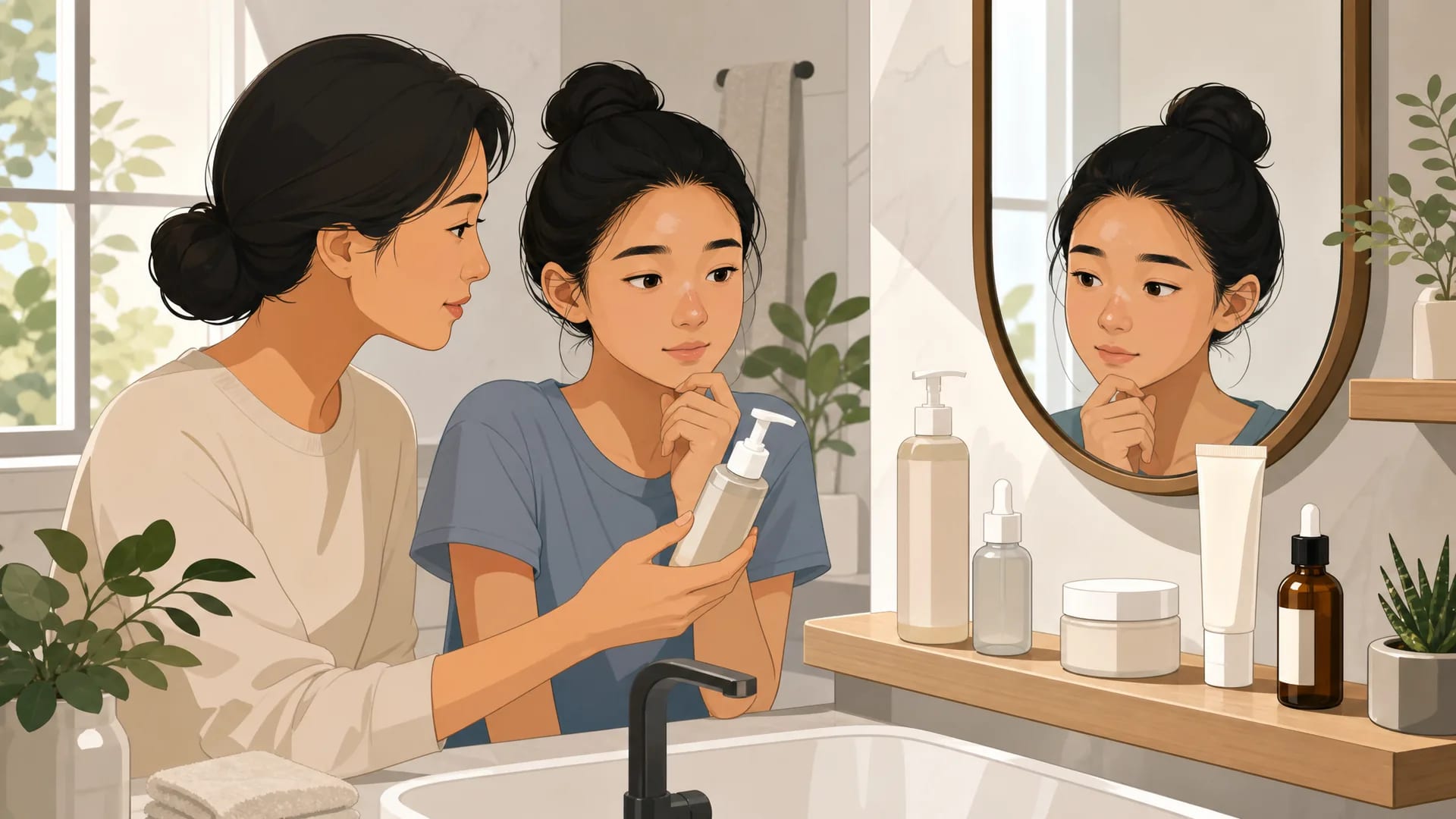
Search "teen skincare" and you'll get a wall of product listicles aimed at seventeen-year-olds with credit cards, not at the parents actually trying to figure out what's safe. That gap is the problem this guide is for. If you're a parent in Malaysia trying to work out when to step in, what's genuinely safe, and what a credible first step looks like, this is written for you, not for your teen's TikTok feed.
When Should Teens Start Skincare? A Realistic Timeline
There's no single correct age. What matters is what's happening to your child's skin, not the number on their birthday cake. Many teens in Malaysia notice their first skin changes during early to mid puberty. The cause is more oil production, not poor hygiene. That distinction is worth holding onto, because it stops you from over-correcting with harsh products when the real issue is a hormonal shift, not dirt.
What Changes at Puberty That Actually Needs Attention
Around puberty, hormones trigger the sebaceous glands to produce more oil. This shows up as shinier skin, clogged pores, and sometimes breakouts on the forehead, nose, and chin. It isn't a hygiene failure. It's biology. Once you see that oil shift, that's the real signal to start a basic routine, not a fixed age like 13 or 15.
Why Earlier Isn't Always Better
Starting early with the right basics is fine. Starting early with the wrong products is not. A common mistake is reaching for acids, retinoids, or "brightening" actives because a teen saw them recommended online. Younger skin, especially skin that's still developing, tends to react more to these ingredients than adult skin does. Slower and simpler wins in the first year or two.
What Counts as Safe Skincare for Teenagers
Safe skincare for teenagers isn't complicated. It's a short list of basics, done consistently, plus a clear sense of what to leave alone until later.
Ingredients and Habits That Are Low-Risk
A gentle, low-risk routine covers three things: a mild cleanser, a basic moisturiser, and daily sunscreen. That's it for most teens starting out. In Malaysia's climate, sunscreen matters more than most parents realise. Year-round UV exposure is one of the biggest drivers of long-term skin damage, more than any single product choice. Consistency with these three steps beats an elaborate ten-step routine every time.
Actives and Treatments Best Left for Later
Exfoliating acids, retinoids, and extractions fall into a different category. These aren't automatically dangerous, but they carry more risk of irritation, sensitivity, or scarring if used incorrectly, and teenagers are often the ones least equipped to judge "correctly." A 14-year-old dealing with new oiliness and breakouts needs a different starting point than a 19-year-old with years of inconsistent product use. Treating both the same way is where most generic advice online goes wrong. If your teen wants to go beyond the basics, that's a conversation for professional guidance, not a shopping cart.
What Non-Invasive Skin Treatment for Kids Really Means in Malaysia
"Non-invasive" is a term parents encounter often but rarely have explained plainly. It means no needles, no cutting, no chemical peels strong enough to break the skin barrier, and no procedures that require downtime or recovery.
Non-Invasive vs Clinical or Aesthetic Procedures
Clinical or aesthetic procedures, laser treatments, chemical peels, injectables, sit at the other end of the spectrum. They're built for specific medical or aesthetic concerns and typically aren't appropriate for developing skin. Non-invasive skin treatment for kids and teens in Malaysia should mean assessment and conditioning: understanding the skin first, then gently supporting it. It shouldn't mean anything that alters the skin's structure.
How Korean Skin Conditioning Adapts for Malaysian Heat and Humidity
Korean skin-conditioning protocols, adapted from Mikwang Academy in Seoul, are built around gradual, non-invasive conditioning rather than aggressive treatment. That approach translates well to skin that's still developing in Malaysia's heat and humidity, where excess oil and clogged pores are a bigger daily reality than they are in cooler climates. Instead of forcing results, the method works with the skin's own hydration and oil balance over time. There's more detail on Korean skin conditioning adapted for tropical heat if you want to understand the full method. It's also worth understanding the difference between skin conditioning and a facial, since the two get confused constantly and aren't the same service.
Red Flags to Watch for in Teen Skincare
Most teen skincare problems don't come from doing nothing. They come from doing too much, too aggressively, based on advice from a stranger online.
Warning Signs in Products and Routines
Watch for multi-step routines borrowed from adult skincare influencers, high-percentage acids or retinoids used daily, and cleansing more than twice a day. Over-cleansing strips the skin's natural oil barrier, which often makes oiliness and breakouts worse, not better. That's the opposite of what your teen is trying to fix. If a routine involves five or more active ingredients layered together, that's a red flag regardless of who recommended it.
Warning Signs in Your Teen's Skin
Persistent redness, unexplained irritation, breakouts that don't improve after a few weeks, or any sign of scarring are all reasons to get a professional opinion rather than trying another product. It also helps to know how teenage acne differs from adult acne, because the drivers, and the right response, aren't the same. Teen acne is usually hormone-driven and responds to gentle, consistent care. Treating it like stubborn adult acne can lead to over-treatment.
How to Support Your Teen Without Pushing Products
This part isn't really about ingredients. It's about how you approach the conversation.
Starting the Conversation Without Making It About Appearance
Lead with how their skin feels, not how it looks. Ask if it's itchy, oily, tight, or uncomfortable, not whether they're worried about a breakout showing. Framing it around comfort and function, rather than appearance, takes pressure off a topic that's already loaded for most teenagers. Listen more than you advise at first. Teens are far more likely to stick with a routine they feel they chose, rather than one handed to them.
Giving Them a Credible First Step Instead of a Shopping List
Instead of buying whatever's trending, offer something more useful: an actual understanding of what their skin needs. That's a very different starting point from a basket of products picked off social media, and it builds a habit of evidence over guesswork worth more long-term than any single item on a shelf.
A Parent-Teen Skin Assessment as the First Step
If you only do one thing after reading this, make it this: get an actual read on your teen's skin before buying anything.
What a Free Skin Assessment Involves
Saebit's Skin Assessment and JANUS Pro scan are built around a non-invasive, trackable process. It takes about 90 seconds and gives you a Personal Skin Profile, a clear picture of what's actually happening with your teen's skin, rather than a guess based on what looked convincing online. It's a proper skin assessment instead of a quiz, which matters because quizzes guess and scans measure. If you're unfamiliar with the scanning process itself, it's worth reading how a JANUS Pro skin scan works before booking, so you know exactly what your teen will experience.
Why Tracking Beats Guessing
A one-off assessment tells you where things stand today. Tracking over time tells you whether what you're doing is actually working, which is the whole point. A Personal Skin Profile lets you and your teen see real change, not assumed change, and adjust the routine based on what's showing up rather than what a product label promised. Once you have a baseline, building a consistent routine that actually works gets a lot more straightforward, because you're working from actual data instead of trial and error.
If you're in Bandar Sunway, Subang Jaya, Puchong, Shah Alam, Petaling Jaya, Bangsar, Taman Tun Dr Ismail, or Cyberjaya, the most useful next step isn't another product. It's a free 90-second Skin Assessment for your teen, a non-invasive, low-risk way to know what you're actually dealing with before you spend a ringgit on anything.