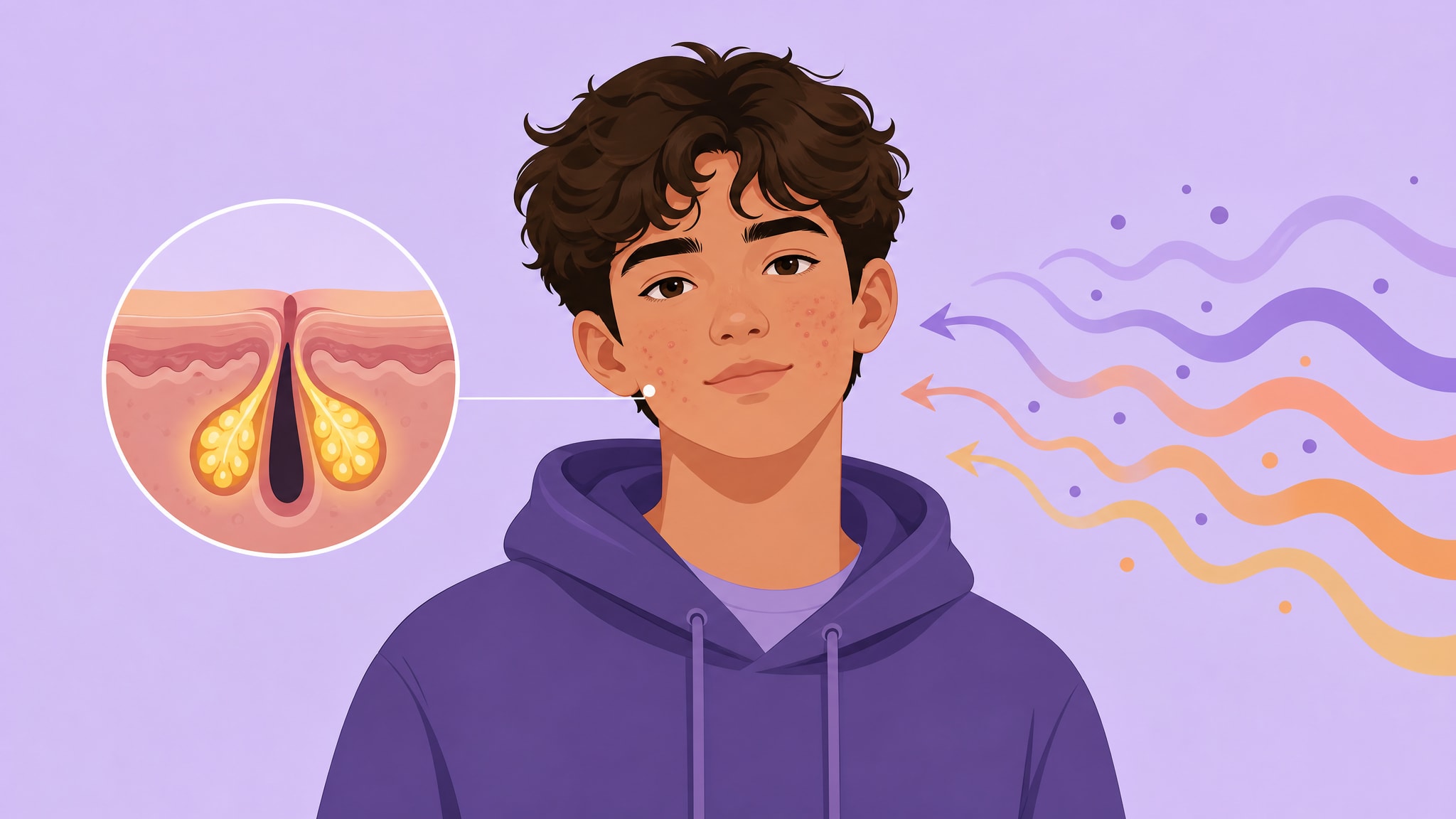
Breaking out during your teenage years is a biological event, not a personal failure. When you ask why do teens get acne, the answer sits in the interaction between developing hormones, changing skin biology, and the environment you actually live in. Understanding these causes of teenage acne removes the shame attached to breakouts and replaces it with something you can act on. Your skin is going through a real developmental phase right now, and that phase needs conditioning, not punishment.
This guide explains the physiological and environmental drivers behind puberty acne causes, so you can stop guessing and start understanding. We'll look at how internal changes meet external factors in Malaysia's tropical climate to create problems that are specific to young skin here. Knowing the mechanism helps you tell the difference between a temporary fluctuation and a pattern that needs professional support.
Hormonal Changes and Puberty Acne Causes
Hormones drive most of what you see in the mirror right now. During puberty, androgen levels typically increase fivefold, and this directly stimulates the sebaceous glands to enlarge and produce more sebum across the face and body. The surge is a standard part of development. It happens regardless of how often you wash your face or which products you're using.
How Androgens Drive Oil Production
Androgens bind to receptors on your sebaceous glands and tell them, at a cellular level, to make more oil. These hormones don't just increase the volume of sebum; they change its composition, making it thicker and more likely to trap debris inside the follicle. You can't scrub away this signal, because it starts deep in your endocrine system, not on the surface of your skin.
Why Breakouts Peak During Growth Spurts
Growth spurts are periods of intense hormonal volatility, where your body keeps recalibrating its baseline. SAEBIT's JANUS Pro imaging consistently shows elevated sebum levels in the T-zones of Malaysian teens aged 13-19, and that lines up with how often they report breaking out during these rapid development windows. The timing of your breakouts often maps to these invisible physiological milestones, not to any external mistake you've made.
Sebum, Pores, and Bacteria: The Acne Cycle
Oil alone doesn't cause acne. The problem starts when excess sebum interacts with other factors to block the pore. Teen skin needs conditioning and tracking rather than aggressive treatment, because barrier function is still developing alongside the hormonal shifts driving it. Stripping the skin disrupts that development, and it often triggers a compensatory overproduction of oil that makes the original issue worse.
When Excess Oil Meets Dead Skin Cells
Inside the follicle, sticky sebum binds with keratinocytes that should have shed naturally, forming a micro-comedone. This plug creates an oxygen-poor environment, and that sets the stage for inflammation long before you see a visible bump on the surface. The process is mechanical. Surface-level cleansing can't reach the blockage forming underneath it.
The Role of C. acnes in Inflammation
Cutibacterium acnes lives on healthy skin normally. It only becomes a problem once it's trapped in a blocked pore. There, it feeds on the accumulated sebum and produces inflammatory byproducts that trigger the redness, swelling, and pain of your immune system responding. Telling the difference between simple congestion and this active inflammatory response matters, because each state needs a different approach.
Why Malaysian Humidity Makes Teen Acne Worse
Your environment multiplies every internal factor above. High ambient humidity slows sweat evaporation, so moisture and salts sit on the skin and mix with sebum to congest pores. If you want to understand why your skin produces excess oil locally, you have to look past biology to the tropical air around you.
Sweat, Heat, and Barrier Stress
Constant heat keeps your pores dilated and your sweat glands active all day. That persistent moisture stresses the skin barrier and gives bacteria a warm, damp place to thrive. Standard skincare routines built for temperate climates often fail here, because they don't account for this relentless thermal load.
Adapting Skincare for Tropical Climates
Heavy creams and occlusives that work fine in dry winters become suffocating traps in Malaysian weather. Korean skin-conditioning protocols adapted for tropical climates prioritize lightweight hydration over heavy occlusives, specifically to stop sweat from getting trapped in young, oily skin. Learning about adapting Korean protocols for tropical weather helps you pick textures that support your barrier instead of adding to the congestion.
Lifestyle Factors That Influence Teen Breakouts
Hormones set the baseline, but daily habits move the severity up or down. Academic pressure, exam stress, and irregular sleep raise cortisol, which stimulates oil production on its own, even after pubertal hormones settle. Once you recognize these secondary triggers, you can manage flare-ups that seem disconnected from your growth pattern.
Stress, Sleep, and Cortisol Spikes
Cortisol works as an alarm signal, telling your sebaceous glands to produce protective lipids in response to perceived threat. Chronic sleep deprivation keeps that signal switched on, creating a background hum of oiliness that persists no matter how good your hygiene is. Fixing your sleep and managing stress is a real skincare intervention, not just general wellness advice.
Dietary Triggers vs. Myths
High-glycemic foods may make acne worse in some teens by spiking insulin, but diet is rarely the sole cause of teenage acne on its own. Cutting out entire food groups without tracking anything usually leaves you with nutritional gaps and the same breakouts, since those are mostly driven by hormones and humidity anyway. Watch your own patterns instead of following restrictive trends that don't have evidence behind them for your specific situation.
Tracking Your Skin Changes Over Time
Teen skin is a moving target, and it makes static routines expire every few months. What worked at fourteen may congest your pores at sixteen, simply because your hormonal baseline has shifted again. A professional skin assessment for Malaysian teens gives you objective data points instead of guesswork, so you know what your skin actually needs right now.
Why Guesswork Fails Young Skin
Relying on memory or mirrors makes it hard to tell a hormonal cycle apart from a reaction to a new product. Without recorded data, you can't know if a breakout is a predictable monthly pattern or a sign that your moisturizer is too heavy for the season. Objective tracking clears up that confusion, and it stops the constant product-switching that damages young barriers.
Using Professional Imaging to Understand Patterns
Professional imaging captures subsurface inflammation and sebum distribution that stay invisible to the naked eye. This shows whether congestion is improving underneath even while active breakouts are still visible on top, so you can see your current protocol working. For parents who want clarity, our parent-focused guidance on teen skin changes explains how to read these shifts without panicking.
Data turns anxiety into a manageable training plan.
When to Seek Professional Skin Conditioning
Understanding causes helps you recognize when self-care hits its limit. Persistent congestion that doesn't respond to six weeks of consistent cleansing points to a deeper imbalance that needs professional attention. Post-acne marks that linger for months despite sun protection are also a sign your skin needs conditioning support beyond what's on the shelf.
Signs Your Routine Isn't Enough
You need outside help when breakouts leave lasting texture or pigmentation that knocks your confidence. Accurately reading your skin type in humidity is hard when sweat mimics oiliness and dehydration mimics dryness at the same time. A professional assessment cuts through that sensory confusion and identifies what's actually going on.
Conditioning vs. Medical Treatment
SAEBIT focuses on conditioning healthy skin and managing non-medical congestion through non-invasive protocols. We don't diagnose medical acne or prescribe medication. Severe cystic lesions, sudden widespread eruptions, or signs of infection call for a dermatologist. Our role sits alongside medical care, maintaining barrier health and tracking progress between clinical visits.
Building a Foundation for Young Skin Health
Knowing why teens get acne changes your relationship with your reflection, from adversarial to analytical. Shame does nothing useful in skincare; understanding physiology and environment hands you agency over a process that otherwise feels random and punishing. Start with a free 90-second digital Skin Assessment to establish your personal baseline before you invest in products or book any service.