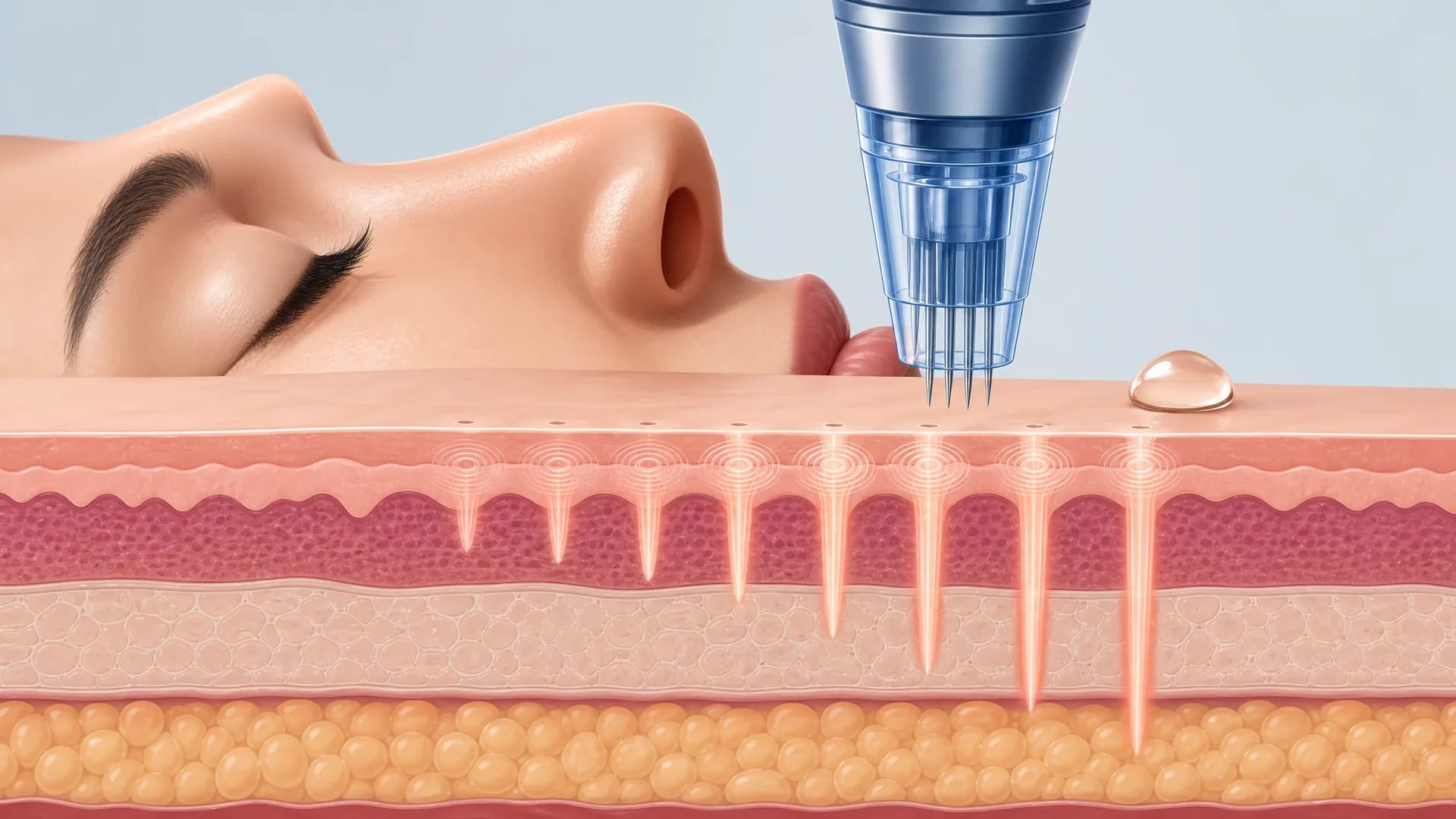
If you've been staring at old acne marks, wide pores, or bumpy texture wondering what actually fixes it, you've probably come across Korean MTS somewhere in your research. It's one of those treatments that gets recommended a lot, but rarely explained well. So let's break it down properly: what it is, how it works, and why Korean MTS is often considered best for post-acne marks, enlarged pores, and uneven skin texture specifically, not just skin that "needs a glow."
What Is Korean MTS and How Does It Work?
MTS stands for Microneedling Therapy System. It uses very fine needles, either on a roller or a pen device, to create controlled micro-injuries in the skin's surface layer. Your skin reads these as small wounds, so it kicks off a repair response: new collagen and elastin production, faster cell turnover, and gradual remodeling of the tissue underneath.
That's the whole mechanism. No magic, no overnight transformation. Just your skin's own repair system, prompted on purpose.
The Science Behind Microneedling Therapy System (MTS)
When the needles create micro-channels, two things happen. First, the wound-healing cascade starts. That's what drives collagen synthesis over the following weeks. Second, those channels temporarily open a path for active ingredients to sit deeper in the skin than they'd normally reach through topical application alone. Combined, this is why MTS is used for concerns that live below the surface, like old scarring, rather than surface-level dullness.
What MTS Actually Does
Microneedling has two mechanisms with real evidence behind them, and only two.
First, delivery. Fine needles create temporary micro-channels in the surface, which briefly raise how well an applied serum penetrates. This is genuine, and it is the main thing a shallow session does.
Second, remodeling. Deeper, controlled injury triggers the skin's wound-healing response, and over several sessions the dermis lays down new collagen. This is what improves pitted scarring. It needs meaningful depth and a trained hand, which is why structural work sits behind practitioner assessment, not a home roller.
Notice these are two different depths doing two different jobs. A shallow session helps absorption. It does not rebuild scars. Any claim that one shallow setting both "just boosts absorption" and "restructures pitted scars" is describing two different treatments and crediting both to the wrong depth.
Depth decides which tier you are in, and the risk changes with it. A shallow pass, around 0.25mm, is actually longer than the whole facial epidermis, which is only about 0.07 to 0.12mm deep. So it passes through the epidermis and just tips into the superficial (papillary) dermis. That is why it can leave faint pinpoint bleeding in places, and why it delivers actives better than a purely surface pass would. The injury is minimal, not absent: this is the low-injury delivery tier. It raises how well a serum absorbs, but it does not reach deep enough to remodel scars.
Why Korean MTS Targets Post-Acne Marks Effectively
Post-acne marks aren't all the same thing. Some are flat pigmentation left behind after inflammation. Others involve actual textural scarring, where the skin's surface has a shallow dip or unevenness from tissue damage during breakouts. Korean MTS is relevant to both, but through slightly different routes.
Breaking Down Scar Tissue and Pigmentation
For textural scarring, the micro-injury process encourages the skin to lay down new collagen in the affected area, which gradually fills in shallow depressions over repeated sessions. For pigmentation, the micro-channels allow brightening or repair-focused actives to penetrate closer to where the pigment sits, instead of sitting on top of skin that's already resistant to absorption. This is the practical answer to whether Korean MTS just works on texture: it doesn't only smooth the surface, it also supports fading pigment left behind by old breakouts.
Understanding how teenage acne differs from adult acne matters here too, since where the marks came from often shapes how they respond to treatment.
Realistic Timelines for Fading Marks
Nobody walks out of one MTS session with marks gone. Collagen remodeling is a slow biological process. Visible change in post-acne marks typically builds across a course of sessions rather than showing up after a single visit. Most people need to think in terms of months, not days, and to track progress with photos rather than daily mirror checks, which won't show much week to week.
How Korean MTS Improves Enlarged Pores and Skin Texture
Enlarged pores are often blamed on genetics alone, but there's also a structural piece: the collagen support around the follicle wall. When that support weakens, whether from age, sun exposure, or ongoing oil and inflammation, the pore looks stretched and more visible.
Collagen Stimulation for Firmer Pore Walls
MTS's repeated micro-injury and repair cycle helps rebuild collagen in the surrounding tissue, which firms up the structure holding the pore in shape. This doesn't shrink pores in the sense of changing their number, but it does tighten the skin around them so they read as smaller and less pronounced.
Smoothing Uneven Texture Over Time
Bumpy, uneven texture is common in humid climates because oil and congestion build up faster, and the surface never quite settles into a smooth, refined state. This connects directly to why Malaysian humidity affects oil and pore size, since more oil production tends to go hand in hand with looser-looking pores and rougher texture. Conditioning the skin through repeated MTS sessions smooths this out gradually, as collagen turnover improves the overall surface quality rather than just addressing one bump at a time.
Is Korean MTS Right for Malaysian Teens and Young Adults?
This is the question that actually matters more than "does MTS work." It works, but not every skin is ready for it right now, and that's a different conversation. A shallow pass, at 0.25mm is the delivery tier: it raises how well an ampoule absorbs, and it is the low-risk end of microneedling. It does not remodel scars, and it does not need to draw blood to do its job. Because pigment problems (PIH) scale with depth, bleeding, and inflammation, a 0.25mm single use needle carries low pigment risk, including on Fitzpatrick IV to V. At this depth the real safety variable is not the needle, it is what you drive through the channels. Barrier-friendly, FA-safe actives such as panthenol, hyaluronic acid, niacinamide, and centella are fine. High-strength acids, retinoids, and low-pH vitamin C are not, because now they are going in through open channels instead of sitting on the surface.
Korean MTS protocol is treated as a conditioning process rather than a single aggressive treatment. This is part of why Korean-style MTS is generally gentler on the skin barrier while still being consistent in its results. It's paced, not rushed.
Why Tropical Heat and Humidity Change the Approach
Skin that's been dealing with constant heat, sweat, and humidity behaves differently from skin in cooler, drier climates. Oil production runs higher, the barrier can be more reactive, and inflammation from breakouts tends to linger longer. That means the standard MTS approach used elsewhere doesn't always transfer directly. Korean academies such as Mikwang Academy in Seoul teach MTS as a layered, gradual conditioning process rather than a one-time fix. That's the protocol logic that gets adapted for Malaysian heat and humidity rather than applied as-is.
Before any MTS conversation, it's worth understanding the basics of a Korean skin conditioning routine for tropical heat, since routine and barrier health lay the groundwork for how well any treatment performs.
Signs Your Skin Might Be Ready (or Not Yet Ready)
Skin that's ready for MTS usually has a settled barrier, no active severe breakouts, and manageable oil levels. Skin that's not yet ready often shows ongoing inflammation, a compromised barrier from over-exfoliation or harsh products, or oil production that's still all over the place. If your skin falls in the second category, treating oil balance and barrier health first, before adding a micro-injury treatment on top, makes more sense than jumping straight to MTS. Reading your skin type accurately in humid climates is a useful starting point for figuring out which category you're in.
What to Expect Before and After a Korean MTS Session
MTS isn't a walk-in, walk-out treatment where prep and aftercare don't matter. In Malaysia's climate, they matter more than usual.
Preparing Your Skin
Before a session, active ingredients like retinoids or strong acids typically need to be paused, since they can make skin more reactive to the micro-injury process. A proper skin assessment beforehand should confirm there's no active infection, no open breakouts, and no barrier damage that would make the treatment counterproductive rather than helpful.
Aftercare and Recovery in Humid Weather
After a session, skin is temporarily more vulnerable, so sun protection becomes non-negotiable, not optional, especially given how intense UV exposure is in Malaysia year-round. Hydration also needs extra attention, since heat and humidity can tempt people to skip moisturizer when the skin already feels damp with sweat. Avoiding heavy sweating, pool time, and harsh actives for the first few days after treatment gives the skin room to actually repair itself instead of fighting fresh irritation on top of the healing process.
How Saebit Approaches Korean MTS: Scan First, Train Second
Here's the honest answer to the question everyone actually wants answered: how do you know if enlarged pores, marks, or texture is the priority for your skin right now? You don't guess it from a mirror. You scan for it.
Skin that developed acne through the humid Malaysian school and university years often carries a mix of shallow scarring and enlarged pores rather than one isolated issue. That's exactly why a single scan-based read matters more than eyeballing your own reflection and assuming you know the full picture.
Saebit's free 90-second Skin Assessment, paired with JANUS Pro scanning, gives you a Personal Skin Profile that shows whether marks, pore size, or texture is the actual priority to address first, before anything gets booked. If you want to understand what your skin scan results actually mean before you go in, that's worth reading too.
This isn't about selling you a treatment. It's about reading your skin properly before deciding what it needs. If post-acne marks, enlarged pores, or uneven texture have been bothering you, the next right step is to skip the guesswork with a real skin assessment and find out where your skin actually stands before your first MTS session.