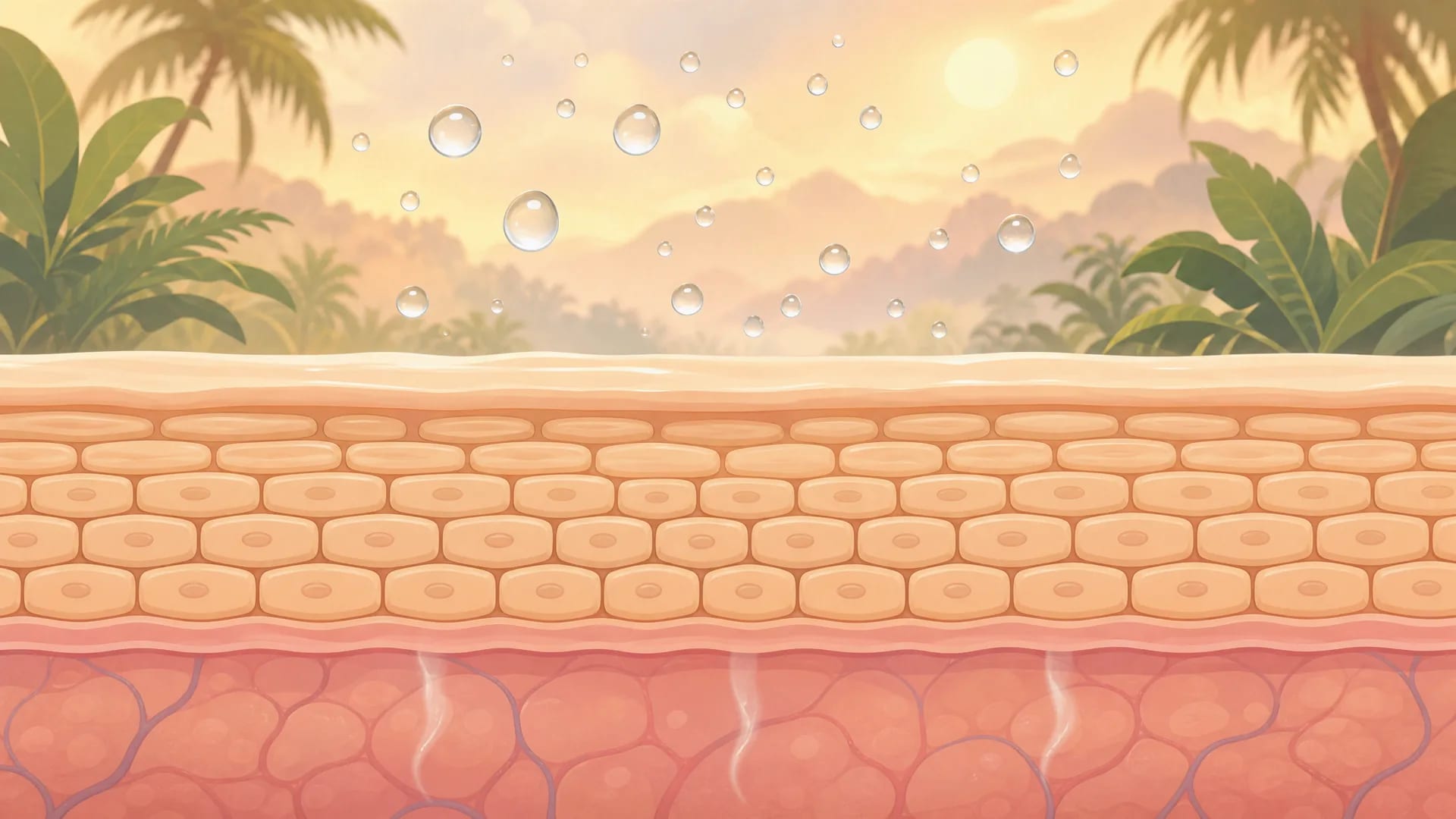
Most skin barrier advice online comes from places with real winters. Dry air, indoor heating, seasonal humidity swings, none of that describes Bandar Sunway, Puchong, or Shah Alam. If you've followed a routine built for a temperate climate and still broken out, the problem might not be your products. It might be that the advice was never written for skin living in Malaysia's humidity in the first place.
How Humidity Changes the Skin Barrier Equation
Your skin barrier is the outermost layer of skin. Think of it as a wall made of skin cells and lipids. Its job is simple: keep water in, keep irritants and bacteria out. When it works well, your skin feels balanced. When it's damaged, you get dryness, sensitivity, and breakouts, often at the same time.
In temperate climates, that barrier constantly loses water to dry air. Skincare advice from those regions focuses on locking moisture in with heavy creams and oils. Malaysia's climate works differently. Understanding how humidity affects your skin barrier here starts with what humidity does to water loss, not what it does to dryness.
What TEWL in Humidity Actually Means
TEWL stands for transepidermal water loss. It's the natural, constant evaporation of water from your skin into the air around you. In dry climates, TEWL runs high because the air pulls moisture out of skin fast.
Malaysia's ambient humidity typically sits in the 70-90% range year-round. That level consistently slows evaporative water loss from skin compared to temperate climates, where humidity swings by season. That sounds like an advantage. Slower water loss should mean better-hydrated skin.
In practice, it means something else. Sweat, oil, and dead skin cells sit on the surface longer instead of evaporating away. Bacteria that thrive in warm, damp conditions get more time to multiply. Your barrier isn't losing water quickly, but it's also not clearing itself the way it would in drier air. That's the trade-off most skincare content never mentions.
Why Your Skin Can Be Dehydrated AND Oily in a Tropical Climate
This is the paradox that confuses most teens in Malaysia. You can have oily skin and a dehydrated barrier at the exact same time. It's not a contradiction. It's how a tropical climate stresses the skin barrier.
Humidity and Oily Skin: The Overcompensation Cycle
Heat and humidity push your sebaceous glands to produce more oil. That's a direct response to temperature, not just hormones. At the same time, if your barrier is compromised, water still escapes from deeper skin layers, just more slowly than in dry air.
Your skin senses that water loss and reads it as dehydration. Sebaceous glands respond by producing even more oil, because oil is one of the ways skin tries to slow water loss. The result is a loop: dehydration triggers oil, oil traps sweat and bacteria against skin, and inflammation follows.
A teen who washes their face twice daily yet still breaks out is often stripping their barrier, not under-cleansing. This pattern is common in humid climates, where sebum regenerates fast after each wash. Each wash removes oil and disrupts the barrier further. Glands overcompensate by producing more oil within hours. By the next morning, skin looks just as oily as before, sometimes with a fresh breakout to show for it.
If this cycle sounds familiar, why your skin runs oilier in Malaysia's climate breaks down the oil-production side of this in more depth.
How to Tell If You're Dehydrated, Not Just Oily
Oily skin and dehydrated skin can look identical at a glance: shine, breakouts, clogged pores. A few signs point specifically to dehydration underneath the oil. Skin that feels tight after cleansing, even though it looks shiny an hour later, is one clue. Fine lines that show up more when you make a facial expression are another.
Redness or a stinging feeling when you apply product, especially anything with active ingredients, also suggests a compromised barrier rather than plain oiliness. Guessing from the mirror only gets you so far. Reading your skin type accurately in humid weather walks through a more reliable way to separate the two.
Skin Barrier in Malaysian Teens: Why Age and Climate Combine
Puberty and Malaysia's climate hit the skin barrier from two directions at once. Neither factor alone explains what most teens experience. Together, they explain almost all of it.
Hormonal Oil Production Meets Environmental Humidity
Puberty raises androgen levels, and androgens directly increase sebum output. That's true everywhere, in every climate. Add Malaysia's constant heat and humidity on top, and oil production runs higher than it would for the same teen in a drier, cooler country.
Teen skin barriers are also still developing. They react more to both heat and product overload than adult skin does. A routine with six or seven active ingredients, borrowed from an adult skincare video filmed in a different climate, can overwhelm a teen barrier that's already working harder just to cope with the humidity. That's a big part of why generic Western skincare advice keeps failing Malaysian teens specifically. It's not that the ingredients are wrong. It's that the climate and the age both change how skin responds to them.
Adjusting Your Routine by Season in Malaysia
Malaysia doesn't have four seasons, but it does have real shifts in humidity, rainfall, and haze that change what your barrier needs.
Monsoon Months vs Dry, Hazy Stretches
During monsoon periods, humidity climbs even higher and rainfall increases. Skin tends to feel heavier and oilier. Breakouts often increase because sweat and oil sit against skin longer between washes. This is when lighter layering matters most: thinner moisturizers, fewer occlusive layers, and more attention to gentle, regular cleansing.
During drier, hazy stretches, humidity drops slightly and airborne particles increase. Skin can suddenly feel tighter or more reactive, even though the weather still feels hot. This is when reintroducing a slightly richer moisturizer, or an occlusive layer at night, actually helps rather than clogging pores.
For a fuller month-by-month approach, adjusting your routine for heat and humidity season by season covers the practical swaps in more detail.
Barrier Repair for Tropical Climate: What to Prioritize
Barrier repair for tropical skin shouldn't be something you only think about after a breakout or a bad reaction. It works better as a year-round baseline: consistent gentle cleansing, daily hydration, and daily sun protection, regardless of season.
Treat seasonal shifts as small adjustments to that baseline, not a reason to overhaul your entire routine every few months. A barrier that's already stable handles Malaysia's swings between monsoon and haze far better than one that's constantly being rebuilt from scratch.
Barrier-First Products for Humid Skin
The instinct to reach for heavy, rich products when skin feels dry or irritated makes sense in a cold, dry climate. In Malaysia's humidity, it usually backfires. Heavy occlusives sit on top of skin that's already retaining sweat and oil longer than it should, and pores clog fast.
Ingredients That Support the Barrier Without Clogging Pores
Humectants like hyaluronic acid and glycerin pull water into the skin without sealing it under a heavy film. In humid air, they work efficiently because there's already moisture around to draw in.
Lightweight ceramides help rebuild the barrier's lipid structure without the greasy finish of thicker, cold-climate moisturizers. Niacinamide supports barrier function while also helping regulate oil production. That makes it one of the few ingredients that addresses both sides of the dehydrated-oily paradox. How niacinamide supports oily teen skin covers how it fits into a teen routine specifically.
Korean skin-conditioning protocols from Mikwang Academy get adapted specifically because Seoul's drier climate calls for different barrier support than Malaysia's constant humidity. That's a useful reminder that even well-regarded skincare systems need adjusting for where you actually live. For a version built around this climate from the start, a beginner Korean skin-conditioning routine built for tropical heat is a practical starting point.
When to Get Your Skin Barrier Properly Assessed
Reading your own skin gets you partway there. It doesn't always tell you whether you're dealing with barrier damage, excess oil, dehydration, or some mix of all three. Guessing wrong means treating the wrong problem, sometimes for months.
Saebit's JANUS Pro scans routinely show teens with both elevated oil readings and reduced hydration levels in the same skin profile. That's the dehydrated-oily paradox showing up directly in real Malaysian skin data. The pattern shows up constantly across teens in Bandar Sunway, Petaling Jaya, Bangsar, Cyberjaya, Damansara, and Subang Jaya, wherever the climate is doing the same thing to skin.
A free 90-second Skin Assessment or a JANUS Pro scan gives you a clear read on what's actually happening under the surface, instead of another generic routine borrowed from a different climate. If you want to understand what the numbers behind a scan actually indicate, what your JANUS Pro scan results actually mean explains it in plain terms.
Before you add another product or cut one out, it's worth getting a proper skin assessment first. Book your Skin Assessment, and find out whether your skin needs barrier repair, oil control, or both, with data instead of guesswork.