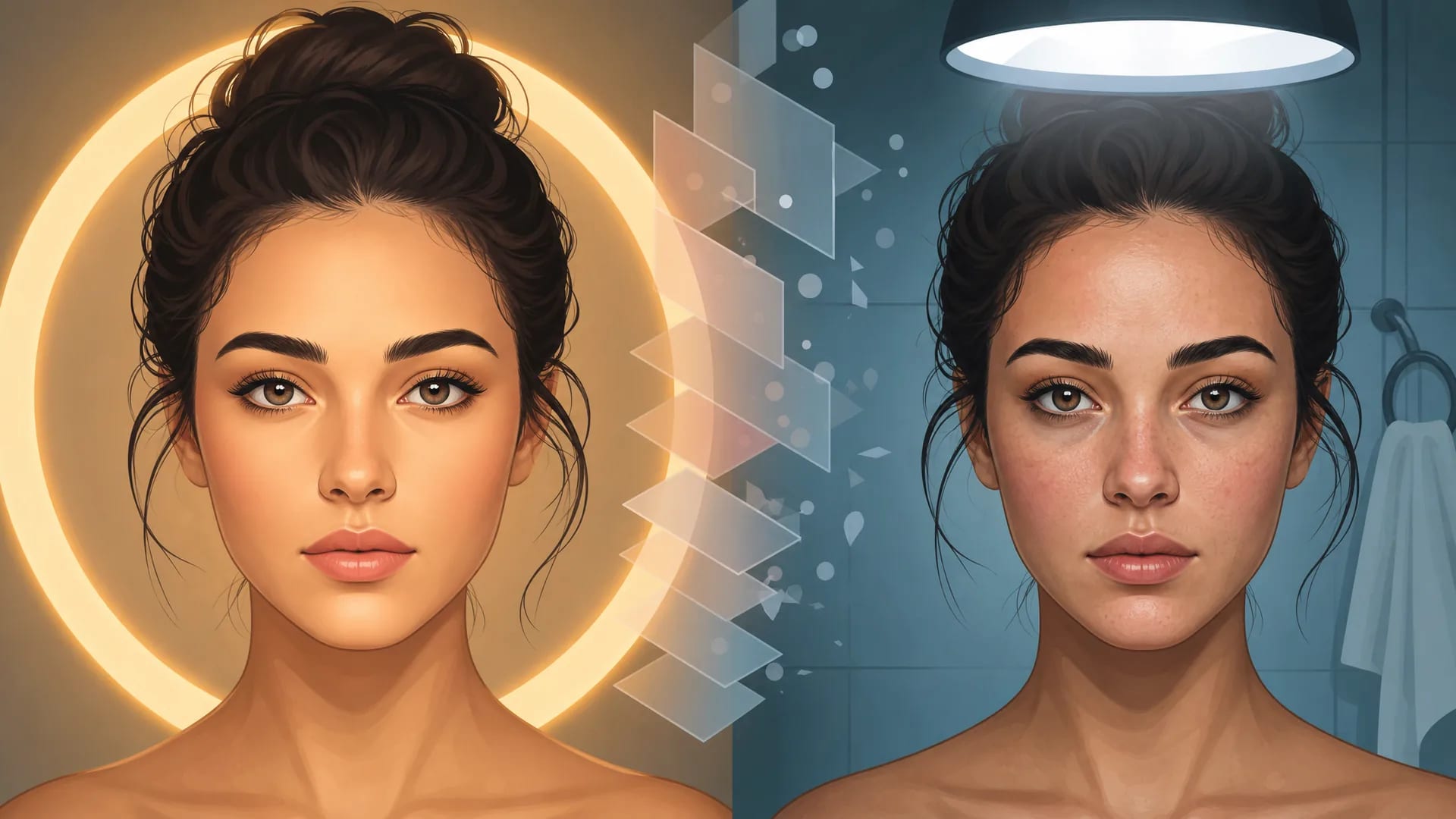
You scroll through a feed, look up at the mirror, and wonder why your skin doesn't look like influencers' skin. It's one of the most common questions teens type into Google or TikTok search, and the honest answer has less to do with your skincare shelf and more to do with cameras, climate, and comparison itself. Let's break it down properly.
Why Your Skin Will Never Look Like an Influencer's Skin on Screen
Start here, because this is the part most people skip. What you're seeing on screen was never just skin. It was skin plus lighting plus a lens plus an app.
Filters, Lighting, and Editing Do More Than You Think
Ring lights flatten shadows and blow out texture before a filter even touches the footage. Smoothing filters soften pores, even out tone, and blur fine lines in real time, often without the creator manually turning anything on. Editing apps go further after filming: patching redness, dimming shine, sharpening only the eyes so the rest of the face reads as soft and even. This isn't a personal failure on your part. It's a photographic effect, and it happens to every face put in front of a ring light, including the influencer's own bare skin off-camera.
Filming Conditions Aren't Real Skin Conditions
A filmed face is lit from one flattering angle, held still, and often filmed indoors in air-conditioning. Your bathroom mirror has none of that going for it. It's overhead light, a stationary reflection, and often a face that's just been through a humid commute or a full school day. Comparing the two is like comparing a stage photo to a candid one. They were never shot under the same conditions, so they were never going to look the same.
The Real Reasons Your Skin Looks Different Day to Day
Once you set the camera effects aside, there are still real, biological reasons your skin looks different from someone else's, and from your own skin last month.
Skin Type and Stage Matter More Than Trends
Every face has its own oil balance, hydration level, and genetic starting point. Someone with more active oil glands will show more shine and more breakout activity than someone else, regardless of what either of them puts on their face. Trends don't account for this. A routine built for dry, mature skin overseas can genuinely fight against oilier, younger skin here. Knowing your own baseline matters more than knowing what's viral, and that starts with understanding how to read your own skin type in humid weather.
Malaysia's Heat and Humidity Change the Rules
Most influencer skincare content is filmed in temperate climates, cooler and drier than what skin experiences here. Malaysia's year-round heat and humidity push oil production and sweat-related congestion higher, which is one reason routines copied from overseas creators often underperform once you actually try them at home in places like Petaling Jaya, Subang Jaya, or Shah Alam. If you want the deeper mechanics of this, there's a full explanation of why Malaysian skin runs oilier than filmed-in-cooler-climate skin. Understanding this one climate fact alone reframes a lot of frustration.
Why Copying an Influencer's Routine Often Backfires
Once you know the baseline is different, it makes sense that copying someone else's exact steps can actually make things worse, not better.
Over-Washing and Over-Layering Actives
A common pattern among teens is washing the face twice daily and stacking three or four trendy actives at once, because that's what a routine video showed. But actives work by disrupting the skin barrier slightly on purpose. Layering too many at once, on top of over-washing, can push a barrier past what it can recover from between uses. The result often looks like more breakouts, more redness, and more visible texture. That's the opposite of the smooth result being chased. If this sounds familiar, it's worth reading about why washing twice daily isn't fixing your breakouts.
Skipping the Step of Actually Knowing Your Skin
Here's a pattern we see often in-studio: a teen who scrubs twice daily and layers three active ingredients may still show more visible texture on a scan than a peer running a simpler two-step routine. Barrier stress reads differently under real measurement than it does on camera. A routine copied without first identifying your own oil balance and hydration level is a guess, not a plan. Skipping that step is the single most common reason a "proven" viral routine doesn't work the same way twice.
What Actually Builds Better Skin Over Time
Good skin isn't a fixed look someone either has or doesn't. It's a trained, tracked outcome, and that reframe matters more than any single product.
Consistency Beats Intensity
Korean skin-conditioning protocols, including approaches adapted from Mikwang Academy in Seoul, treat visible "glass skin" as something built over weeks of tracked conditioning, not a static state someone is simply born with. That's exactly why comparing a single filtered photo to your own bare face is comparing two completely different timelines. A simple, consistent routine, held steady for weeks, will outperform a ten-step viral routine changed every few days chasing the next trend. If you want a structured approach, there's a full guide to building a routine that's consistent, not just trendy.
Tracking Progress Instead of Comparing Photos
The identify, scan, understand, train sequence exists for a reason. You identify what your skin actually needs, scan it for real data, understand what that data means, then train it consistently over time. Comparing photos skips every one of those steps and replaces them with guesswork against an edited image. Progress tracked against your own baseline, week over week, is a far more honest measure than any comparison to someone else's filtered feed.
How a Skin Scan Shows You What Filters Hide
This is where data replaces guessing. A JANUS Pro scan measures your hydration, oil balance, and texture directly, producing a Personal Skin Profile, a real baseline no filter or ring light can fake. It doesn't compare you to an influencer. It shows you your own skin, as it is, right now. From there, what a JANUS Pro scan actually measures and how to read the results become the useful next questions, replacing "why doesn't my skin look like theirs" with "what does my own skin actually need." If you want to understand how those numbers translate into a real routine, it also helps to look at understanding your own skin scan results once you have your profile in hand.
FAQs: Influencer Skin vs. Your Real Skin
Why does my skin look worse than influencers' skin even when I follow their routines? Because their routine was built for a different skin type, a different climate, and often filmed under lighting and filters that changed the visible result before the product even mattered. Copying the steps without matching the baseline rarely gives the same outcome.
Do influencers really use filters, or is their skin naturally flawless? Most on-camera skin content involves some combination of ring lighting, real-time smoothing filters, and post-editing. This is standard across the industry, not a secret exception, and it applies to nearly everyone filmed under those conditions.
Is it normal for skin to look different in photos versus in person? Yes. Lighting angle, camera lens, and screen compression all change how texture and tone appear. A face can look completely smooth on screen and show normal texture in a mirror. Both are "real." They're just captured differently.
How does Malaysia's climate affect skin compared to where most influencers film? Higher heat and humidity mean more oil production and more sweat-related congestion here than in the cooler, drier climates common in a lot of skincare content. That's why a routine built for someone filming somewhere temperate can leave oily, humid-climate skin under-treated or over-stripped.
What should I focus on instead of comparing my skin to social media? Focus on your own measured baseline: hydration, oil balance, and texture. Track it consistently over weeks rather than judging it against a single filtered image someone else posted.
How can I actually track whether my skin is improving over time? Use real measurement instead of memory or photo comparison. A scan that records hydration, oil, and texture data gives you a baseline to check progress against, a far steadier method than comparing yourself to a feed that changes daily.
If you're ready to stop comparing and start measuring, Saebit's free 90-second digital Skin Assessment gives you a real read on your own skin, no filter involved. It's the first step toward a Personal Skin Profile through the JANUS Pro scan, and it's available for anyone across Bandar Sunway, Puchong, Shah Alam, Petaling Jaya, Bangsar, Taman Tun Dr Ismail, Cyberjaya, Damansara, and Subang Jaya who wants data instead of guesswork.