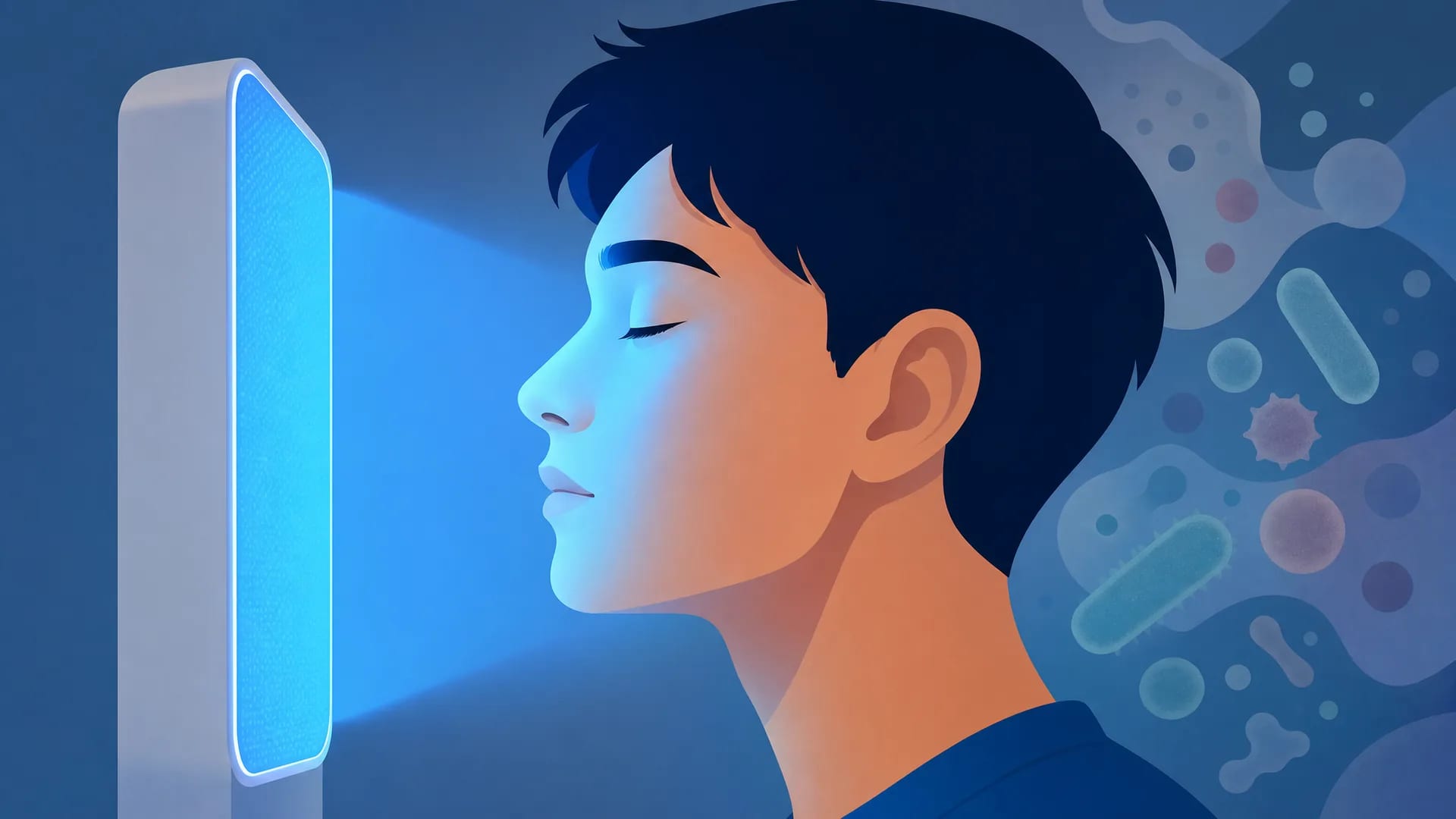
You've probably seen the panels: a teen lying under a glowing blue mask, looking like something out of a sci-fi film. Blue light therapy to treat acne gets pitched everywhere from dermatology clinics to weekend spas. But what does it actually do to your skin, and where does it fall short? Let's break it down like a coach would, plainly, without the hype.
How Does Blue Light Therapy Work for Acne?
Blue light therapy targets the bacteria that live on your skin's surface. It doesn't touch your pores directly. It doesn't change how much oil your skin makes. It goes after one thing: the bacteria that feed acne breakouts.
Think of it as a targeted strike rather than a full defense system. That's useful, but it's also limited. Knowing what it hits, and what it misses, is the whole point of using it well.
Acne Bacteria and Blue Light: The Cellular Reaction
Here's the plain-language version of the science. A bacteria called C. acnes lives on everyone's skin. In small amounts, it's harmless. But when your pores get clogged with oil and dead skin, C. acnes multiplies and triggers inflammation. That's the breakout you see.
This bacteria produces compounds called porphyrins as part of its normal activity. Porphyrins react to blue light. When blue light hits them, it sets off a reaction that damages the bacteria's cell structure. Fewer active bacteria on the surface means less of the inflammation trigger that turns a clogged pore into a red, swollen breakout.
That's the mechanism, in full. It's a real, measurable effect. It's also a surface-level one, and that matters a lot for what comes next.
What Blue Light Therapy Actually Fixes vs What It Doesn't
Blue light therapy reduces surface bacteria load. That's it. It doesn't rebalance oil production. It doesn't hydrate dehydrated skin. It doesn't fade the dark marks or texture left behind after a breakout heals.
If your acne is driven mostly by bacteria sitting on top of already-balanced skin, blue light can help clear things up. But if your skin is producing excess oil, running low on hydration, or reacting to hormonal shifts, blue light only handles one piece of a bigger picture. This is a big part of why so many teens try a few sessions, see some initial improvement, and then watch breakouts creep back. The bacteria come back because the underlying oil and hormone conditions never changed. Understanding how teenage acne differs from adult acne helps explain why a one-size treatment rarely works for a teenager's changing skin.
Blue Light vs Red Light Therapy for Acne
Blue light and red light get lumped together often, but they do different jobs. Blue light targets bacteria on the surface, the mechanism we just covered. Red light works differently. It penetrates deeper into the skin, and it's generally used to calm inflammation and support healing rather than kill bacteria.
Some in-studio treatments combine both: blue light to reduce the bacterial trigger, red light to help calm the redness and inflammation that follows. Used alone, blue light without red light may leave inflamed skin looking less bacteria-affected but still irritated.
Does Blue Light Therapy Help Hormonal Acne?
Hormonal acne is a different animal. Shifts in oil production and inflammation tied to hormone activity drive it, not mainly bacteria overgrowth. This type of acne often shows up along the jawline and chin, and it tends to flare in cycles.
Blue light can still reduce the bacterial component sitting on top of hormonal breakouts. But it won't change the oil output or hormone-driven inflammation causing the breakout in the first place. If your acne pattern looks hormonal, blue light alone is unlikely to solve it. It needs pairing with a plan that addresses oil balance directly.
Is Blue Light Therapy Safe for Teens?
For most teens, blue light therapy counts as a low-risk, non-invasive option. It doesn't involve needles, chemicals, or deep exfoliation. It uses light exposure to trigger a bacterial reaction, a gentler mechanism than many other acne treatments.
That said, "low-risk" doesn't mean "no consideration needed." Teenage skin is still developing. Oil glands, hormone levels, and skin barrier strength are all in flux during the teen years. A treatment that's fine for adult skin can behave differently on skin that hasn't settled into its adult pattern yet.
Blue Light Therapy Side Effects to Know
Most people tolerate blue light therapy well. The most commonly reported effects are mild: some redness right after a session, occasional dryness, or slight sensitivity in the treated area. These usually settle within a day.
Patch-testing before a full session is a smart habit, especially for teens with sensitive or reactive skin. It's also worth getting professional guidance rather than assuming any device or setting is automatically safe. Skin Training Sessions that use only non-invasive methods matter here. For parents weighing light-based treatments against harsher alternatives, non-invasive is a meaningfully lower-risk starting point for skin that's still developing.
Blue Light Therapy in Malaysia's Heat and Humidity
Malaysia's climate changes the equation. Heat and humidity push oil glands into overdrive, and sweat combined with oil creates exactly the environment where acne-causing bacteria multiply fastest. This is true whether you're in Bandar Sunway, Puchong, Shah Alam, or anywhere else dealing with the same tropical conditions.
Blue light therapy reduces the bacteria present at the time of treatment. But if oil production stays high afterward, bacteria have a fast track back to pre-treatment levels. That's why teens in humid climates often see blue light's effects fade faster than teens treating the same acne in drier, cooler climates. A big reason is why Malaysian skin runs oilier in this climate, a factor blue light alone was never built to manage.
The fix isn't more blue light sessions. It's pairing the treatment with a routine built around oil control and hydration balance suited to a humid environment, so bacteria has less opportunity to rebuild.
In-Studio vs At-Home Blue Light Devices
In-studio blue light treatments generally use higher-intensity devices, applied by someone trained to adjust exposure and track how skin responds session to session. That consistency and strength are hard to replicate at home.
At-home blue light devices are usually lower-intensity by design, for safety reasons around unsupervised use. They can still help, but results tend to build more slowly and depend more on the user sticking with a consistent schedule.
Neither option is inherently "better" on its own. The right choice depends on how severe the bacterial load is, how consistent someone can realistically be, and whether the acne pattern actually calls for blue light in the first place.
How Many Sessions of Blue Light Therapy for Acne Are Needed?
There's no single universal number, and any source promising an exact session count is guessing. What's realistic to expect: blue light therapy works cumulatively, not instantly. A single session won't clear active breakouts. Most people considering it are looking at a series of sessions spread over several weeks, with results building gradually rather than appearing overnight.
The bigger variable isn't the session count. It's whether the acne being treated is actually the bacteria-driven type blue light is designed for. That's a question worth answering before committing to any session plan.
Why a Skin Scan Should Come Before Blue Light Therapy
Here's the coaching problem with blue light therapy as most people use it: they start the treatment without knowing what's actually causing their acne. Bacteria, oil, hormones. These all produce visible breakouts, but they need different responses.
Saebit's Personal Skin Profile shows whether a teen's breakouts are bacteria-driven, oil-driven, or hormonal, the exact distinction blue light therapy alone can't make. Without that information, blue light is a guess dressed up as a solution.
Coaches at Saebit treat blue light as one tool in a training plan, not a cure. It gets paired with hydration and oil-balance steps drawn from Korean skin-conditioning protocols, so the bacterial reduction blue light offers actually sticks instead of reversing within weeks. A teen in Subang Jaya used blue light sessions without adjusting oil control, and saw the surface clearing fade within weeks. That's a common pattern in Malaysia's humidity, and one you can avoid with the right groundwork first.
Blue Light Therapy Acne Before and After: What Changes to Actually Look For
Before-and-after photos of blue light therapy for acne often show reduced redness and fewer active pustules. What they usually don't show is oil control, hydration levels, or whether post-acne marks and texture have changed at all. Those require treating post-acne marks and texture separately, since blue light was never designed to fade marks or smooth texture.
If you're evaluating before-and-after results, look specifically at whether the bacterial-type breakouts have cleared, and check whether the surrounding oil and hydration issues were addressed too. A photo showing less redness doesn't tell you the whole story.
This is exactly why what your skin scan results actually reveal matters more than jumping straight to a treatment. A scan, including how the JANUS Pro scan works, shows the actual breakdown of what's driving your specific skin, instead of applying a generic treatment and hoping it fits.
If you've been wondering why you might still be breaking out despite a clean routine, the answer is usually that the routine is treating the wrong thing. Blue light therapy can be a genuinely useful tool. But it's a tool that works best when you know exactly what you're aiming it at.
Start with a free Skin Assessment and book a JANUS Pro scan before deciding if blue light therapy belongs in your routine. It takes 90 seconds to find out whether your acne is bacteria-driven, oil-driven, or hormonal, and whether blue light is actually the right tool for it, or just one piece of a bigger plan.