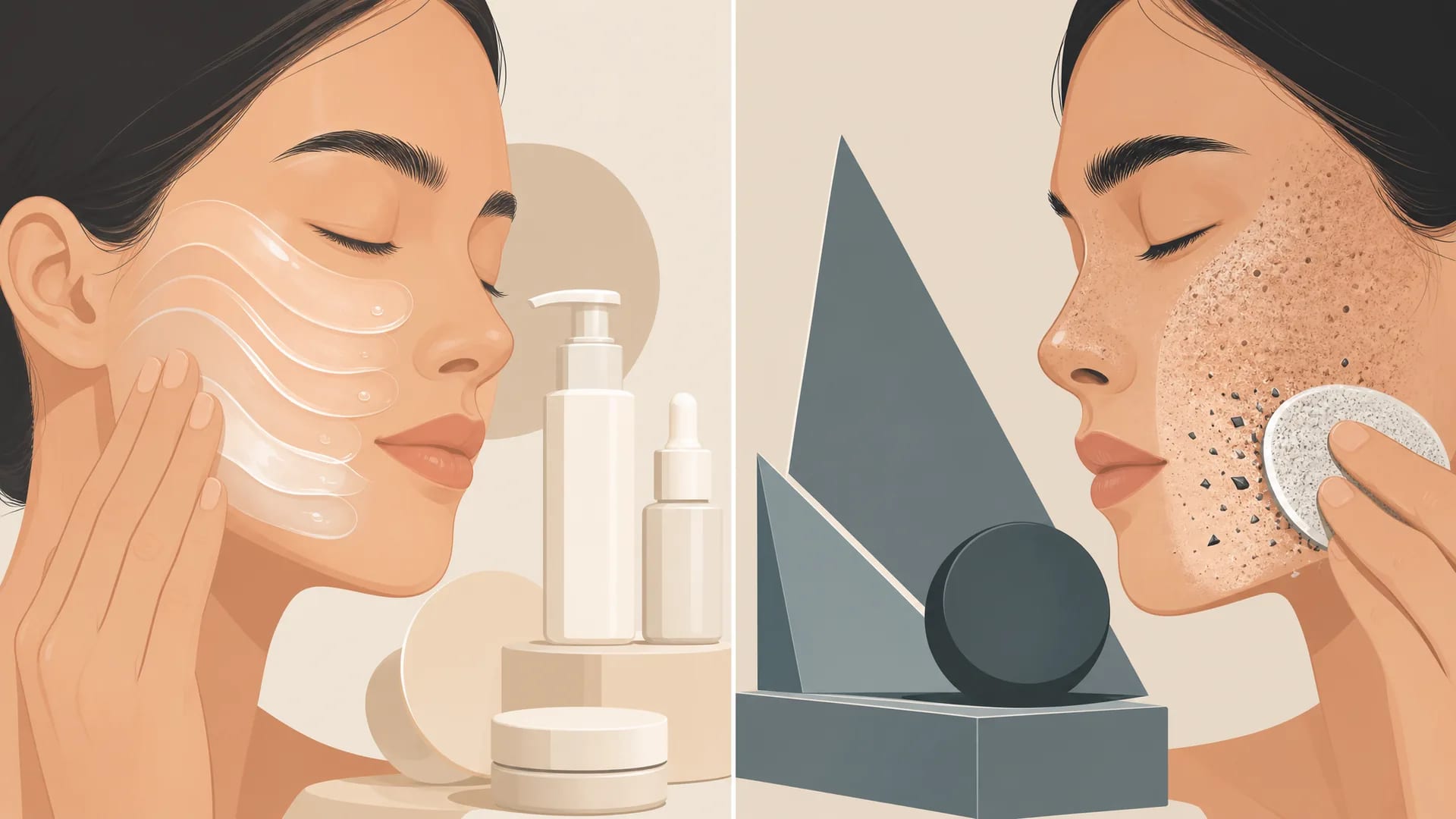
Your skin feels bumpy, congested, or dull, so the obvious move seems to be exfoliating harder. But skin conditioning versus exfoliation is not a contest between two ways to get clearer skin. They do different jobs. Most skincare confusion comes down to one mix-up: treating conditioning and exfoliation like they're the same job. They're not. One builds your skin's resilience over time. The other clears away what's already sitting on the surface. Mix them up and you get breakouts, redness, and stubborn dullness. It's the single most common pattern we see across Petaling Jaya, Subang Jaya, and Bandar Sunway clients who've been guessing from social media.
For teens and young adults in Malaysia, the difference matters even more. Heat, humidity, sweat, sunscreen, makeup, late nights, and frequent cleansing can create a skin environment that is both congested and easily irritated. Your skin may need clearer pores, but it may also need more stability. Those needs can exist at the same time.
This article breaks down what each one actually does, how to tell which your skin needs right now, and how to build both into a routine without overdoing it.
What Skin Conditioning Actually Means
Skin conditioning is the ongoing work of building barrier strength, hydration, and oil balance. It's not a single product or step. Think of it like a training plan, not a one-off workout. Conditioning does not promise an overnight transformation. Its value is that it makes skin behavior more stable over time.
Your skin barrier is the outer layer that keeps moisture in and irritants out. Conditioning strengthens that layer over weeks, not overnight. It's cumulative. The same way fitness improves through repeated, consistent training rather than one hard session.
This matters more in Klang Valley, where indoor air conditioning and outdoor humidity put constant stress on the barrier. Skin that isn't conditioned well shows it fast: tightness, flaking, or a dull, uneven tone.
How Conditioning Is Different From "Just Moisturizing"
Moisturizing is one small piece of conditioning, not the whole plan. A moisturizer sits on top of skin and holds water in for a few hours. Conditioning is broader. It includes hydration, but also oil balance and barrier repair, tracked over time.
That's why two people can both "moisturize daily" and get completely different results. One might be layering the wrong ingredients for their oil levels. The other might be conditioning correctly and seeing steady improvement. The difference is whether you know your starting point. That's why learning to read your skin type accurately matters before you build a routine around guesswork.
When skin is conditioned well, it may look less tight after cleansing, feel less stingy when products are applied, and recover more predictably after a breakout or a humid day. It can also make targeted steps, including occasional exfoliation, easier to tolerate.
What Exfoliation Actually Does to Your Skin
Exfoliation removes dead skin cells sitting on the surface. That's it. It doesn't hydrate, and it doesn't repair your barrier. Depending on the product or treatment, it may also help loosen material inside pores. This can make skin feel smoother, help makeup sit more evenly, and support a clearer-looking complexion when congestion is part of the picture.
Used correctly, exfoliation improves texture, fades rough patches, and helps clogged pores clear out. Used too often, it strips healthy skin along with the dead cells. That's where most of the damage we see actually starts.
Physical Vs Chemical Exfoliation, Plainly Explained
Physical exfoliation uses friction, scrubs, brushes, textured cloths, to manually rub dead cells off. It's fast but harder to control, and it's easy to overdo without realizing it.
Chemical exfoliation uses acids or enzymes to dissolve the bonds holding dead cells together. AHAs (like glycolic or lactic acid) work mainly on the surface and help with dullness. BHAs (like salicylic acid) go deeper into pores and help with congestion. Enzyme exfoliants are gentler still. They break down dead cells without much irritation, which makes them a better starting point for teens and beginners.
Why Over-Exfoliating Backfires in Humid Climates
Over-exfoliation does not always look like obvious peeling. It can show up as a quiet loss of stability: products that used to feel fine now sting, skin gets shiny but feels tight, redness lingers, or small breakouts seem to appear everywhere at once.
You may also notice that you are chasing a result that never lasts. Skin looks smooth for a day, then becomes rough, uncomfortable, or congested again. That cycle can tempt you to exfoliate even more. Usually, it is a reason to pause and reassess.
Malaysia's average humidity sits well above 70% year-round. That keeps sweat and oil sitting on skin longer than in drier climates, which changes how often exfoliation is actually useful.
Here's the trap: humid, oily-feeling skin makes people assume they need to exfoliate more. Often it's the opposite. Skin that's already stressed by heat and sweat needs its barrier protected, not scraped away daily. Over-exfoliating in this climate strips the barrier faster than it does in cooler, drier places. That leads to more oil production, more breakouts, and more sensitivity, not less. Understanding how humidity affects your skin barrier explains why a routine copied from a drier-climate influencer often doesn't translate here.
Skin Conditioning Vs Exfoliation: The Core Differences
Conditioning builds resilience. Exfoliation refines texture. One is ongoing maintenance; the other is a periodic tool you reach for with a specific goal.
Conditioning happens daily and works quietly in the background. Hydration, barrier repair, oil balance, repeated consistently. Exfoliation happens occasionally and works fast: smoother texture, clearer pores, brighter tone, but only for a few days at a time.
Neither replaces the other. Exfoliate heavily on a skin with a weak barrier and it looks worse, not better. There's no foundation to protect the freshly exposed layer underneath.
Which One Should Come First in a Routine
Condition first. Exfoliate second, and only once your barrier can handle it.
If you're just starting to build a routine, spend two to three weeks focused purely on hydration and barrier support before introducing any exfoliating step. This gives your skin a baseline of resilience. Exfoliation then refines what's already stable instead of aggravating what's already fragile.
For someone whose skin is tight, flaky, or reactive, exfoliating first is like sprinting before you've warmed up. It's the fastest way to injury.
How to Know Which One Your Skin Needs Right Now
You don't need a dermatology degree to read the basic signals. Your skin is usually telling you which one it needs. You just have to know what to look for.
Signs You Need More Conditioning
- Skin feels tight, especially after cleansing
- Visible flaking or rough patches that aren't from dead cell buildup
- Redness or a stinging feeling when you apply products
- Dullness that doesn't go away even after a good night's sleep
- Oil production that swings between very oily and very dry in the same day
Signs You're Ready for Exfoliation
- Texture feels rough or bumpy to the touch, but skin isn't irritated
- Clogged pores or small bumps, especially around the nose and forehead
- Makeup or sunscreen sits unevenly, like it's catching on something
- Dullness that comes with visible buildup, not tightness or flaking
- Breakouts that feel like trapped congestion rather than active inflammation
A 17-year-old in Subang Jaya with oily, congested skin often needs enzyme resurfacing once a week plus daily barrier support, not the daily scrub-and-strip cycle most teens default to. That combination, conditioning as the daily habit and exfoliation as the occasional reset, is usually the fix. Not more products layered on top of a stripped barrier.
Building Both Into a Routine Without Overdoing It
The most effective routine is rarely the most crowded one. Begin with a clear priority, such as reducing visible congestion, improving comfort and hydration, or creating more consistency around breakouts. Then keep the foundation steady long enough to see what is actually changing.
A workable rhythm: condition daily, exfoliate weekly or every two weeks. Daily conditioning includes gentle cleansing, hydration, and barrier-supporting ingredients. Exfoliation gets scheduled in, not squeezed in whenever skin "feels rough."
Korean skin-conditioning protocols, adapted from Mikwang Academy in Seoul, treat exfoliation as a targeted tool used in cycles, not a daily default step. Most teen skincare content on social media frames it the opposite way, pushing daily scrubs and acid toners as non-negotiable steps.
Frequency is personal. Some skin tolerates a gentle exfoliating step once or twice a week. Other skin needs less, especially when it is reactive or already using active treatments. The goal is not to reach the highest frequency. The goal is to use the lowest effective amount that supports your priority without disrupting comfort.
Tracking matters more than guessing here. Skin changes week to week with heat, stress, sleep, and hormones. What worked last month might not fit now. Someone recovering from breakouts might benefit from texture-focused treatments like Korean MTS once their barrier is stable enough to handle it, rather than relying on home exfoliation alone. And if breakouts keep returning despite a careful routine, it's worth checking whether over-cleansing is backfiring before adding another exfoliating step on top.
If you're just getting started, a beginner conditioning routine for tropical heat gives a simpler starting sequence than most generic routines built for cooler climates.
When to Get a Professional Read on Your Skin
Your skin does not need every trend. It needs a routine that can tell the difference between buildup to address and a barrier to support. Give it consistency, watch its response, and let the evidence guide the next step.
Self-diagnosing from social media usually confuses the two. A video that calls dullness a "dead skin problem" might send someone straight to a scrub, when the real issue is dehydration. A video that calls congestion a "hydration problem" might send someone straight to heavier moisturizer, when the real fix is a targeted exfoliant.
Saebit's JANUS Pro scan separates barrier strength from surface texture readings, so a Skin Passport can show whether dullness is actually dehydration rather than dead skin buildup. That distinction is hard to guess at home, but it's the whole difference between conditioning and exfoliating correctly.
Once you have that read, what your skin scan results actually mean turns the numbers into a plan you can actually follow, instead of another list of products to try and hope for the best.
If you're in Bandar Sunway, Puchong, Shah Alam, Cyberjaya, or anywhere nearby and you're still not sure whether your skin needs more hydration, more resurfacing, or both, don't keep guessing from conflicting advice. Take the free skin assessment and get a clear, personal answer in 90 seconds.